

The Vision Problem Nobody Talks About
Every CEO has a vision. Most of them even have a good one. Yet the real problem isn’t vision. It’s the gap between what you say and the thousands of choices your team makes each day. That gap is where strategy goes to die. The issue is decision architecture, and most leaders never design it on purpose.
I’ve watched this play out firsthand. You set a clear direction. You share it well. Then six months later, you wonder why results feel sluggish. The answer is almost never about effort or talent. It’s about how decisions actually flow through your org. Who makes them? What data do they use? How fast do they move?
The “visionary CEO” model isn’t wrong. It’s just not enough anymore. Decision architecture is the missing layer between bold strategy and real results. The leaders who build it gain a massive edge. If you’ve ever wrestled with making tough calls under pressure, you know how much structure matters.
What Decision Architecture Actually Looks Like
A decision engine is not a piece of software. It’s the operating system of your org. It shapes how choices get made at every level, every day.

The Five Core Parts
Think of decision architecture as having five parts:
- Decision rights: Who actually decides?
- Decision criteria: What factors matter most?
- Information flow: What data reaches the right people, and when?
- Escalation logic: What gets pushed up, and what doesn’t?
- Feedback loops: How do you learn if the choice worked?
If you’re a technical leader, this should feel familiar. It’s basically network design. You’re building the routing protocol for how decisions travel through your org. You define the shape, set the rules, and monitor throughput. Without that design, decisions bounce around like packets with no route table.
Jeff Bezos gave us a simple but powerful frame here. He splits decisions into “one-way doors” and “two-way doors.” One-way doors are hard to reverse, so they need careful thought. Two-way doors are easy to undo, so move fast. Most groups treat every decision like a one-way door. That kills speed.
Decision Debt: The Silent Killer
Every technical leader knows about tech debt. However, few talk about decision debt. It’s just as harmful.

Decision debt builds when you leave key questions open. It grows when ownership is unclear. It compounds when clashing priorities never get sorted. It shows up as meeting bloat, rehashed debates, and total paralysis.
Decision debt also drives your best people away. Gallup research shows only 15% of workers feel they can make choices without needless approval. High-autonomy orgs report 21% higher profits. Your A-players won’t stick around if they can’t get decisions made. Period.
From OODA Loops to Decision Architecture
John Boyd built the OODA Loop for fighter pilots. Observe, Orient, Decide, Act. It’s a cycle of rapid sense-making and action. And it maps well to how executives should design decision architecture.
Here’s what most people miss. The “Orient” phase is where groups break down. Teams observe data just fine. They collect dashboards, reports, and metrics. But they read that data through old mental models. They orient using yesterday’s thinking in today’s world.
The systems-architect CEO always rechecks the Orient phase. You update the mental models. You challenge old beliefs. You make sure your team reads the field as it is, not as it was last quarter.
McKinsey found that fast-deciding companies are 2x more likely to beat peers on revenue. Only 20% of leaders said their orgs excelled at decisions. That means 80% are losing to decision friction right now.
Mapping Real Decision Flow, Not Org Charts
Most org charts are fiction. They show reporting lines, not how decisions truly flow. In practice, choices follow informal paths. Who trusts whom? Who holds the context? Who has the pull to make things stick?

A strong decision architecture starts by mapping what actually happens. This is just like how a network architect runs a traffic study before a redesign. You look at real patterns, not what the diagram says should happen.
For example, take the last 10 big calls your org made. Who truly drove each one? How long did it take? What info did the decider have? This exercise will surprise you. The gap between the formal chart and the real flow is where most waste hides.
Once you see the real picture, you can reshape it on purpose. That’s the core work of decision architecture. You stop hoping for good outcomes. Instead, you engineer the system that creates them.
The AI Layer Changes Decision Architecture
AI adds a brand-new design problem to decision architecture. You now have to draw clear lines between three zones:
- Fully automated: AI decides and acts. No human in the loop.
- AI-assisted: AI suggests. A human approves.
- Human-only: Judgment, ethics, or context make this a people choice.
This isn’t a tech question. It’s a leadership design question. Get the line wrong one way and you leave huge gains on the table. Get it wrong the other way and you automate choices that need human judgment.
McKinsey’s 2023 AI report found that 40% of groups call this boundary a top-three challenge. Gartner reports that AI-aided decisions improve speed by 25%, but only with clear human oversight. For a deeper dive on this topic, see my post on AI strategy beyond the hype.
As a CTO leading engineers who build AI-driven solutions, I see this tension every week. The pull is to automate everything. The discipline is knowing where the human must stay in the loop.
Decision Architecture in Constrained Settings
In federal and defense work, decision architecture isn’t optional. It’s baked into the structure. Authority to Operate processes, change control boards, and buying frameworks all impose rigid decision paths.

The average ATO process takes 12 to 18 months. That’s a massive constraint. However, the best leaders don’t just endure it. They design around it. They treat the constraint as a design input, not an excuse.
For instance, you can run parallel work streams. You can front-load docs. You can build reusable security packages. The constraint stays fixed, but your decision architecture within it sets your actual speed.
General McChrystal proved this at scale. When JSOC shifted from a rigid chain of command to a networked decision model, their tempo rose 17x over four years. They kept quality high. They just moved faster by reshaping how decisions flowed.
Servant Leadership as Decision Architecture
Here’s where decision architecture connects to something I care deeply about: servant leadership.
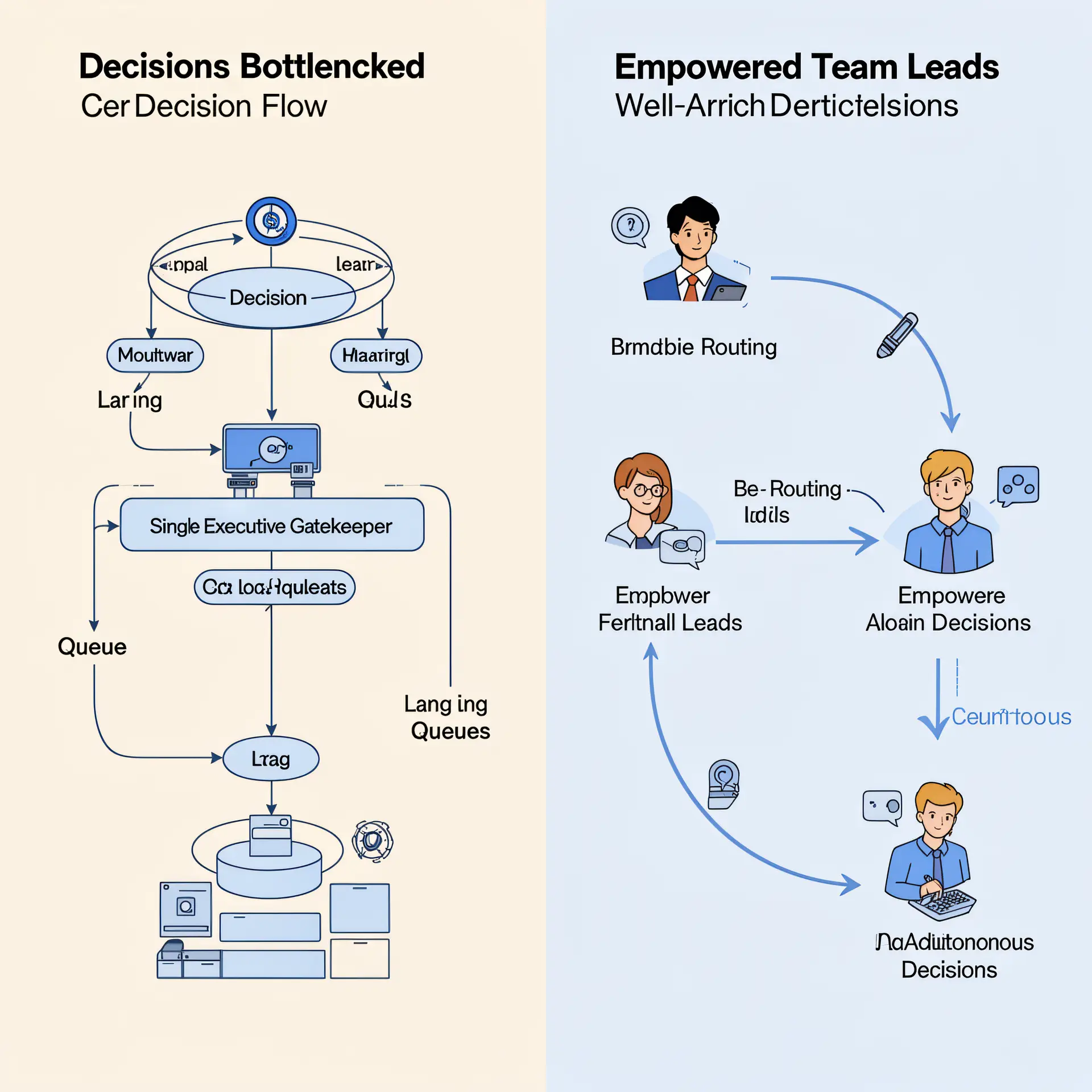
Pushing decisions down to the lowest skilled level is not giving up control. It’s design. You’re not just telling people “you’re empowered” in a team meeting. You’re giving them clear decision rights, the right info, and real power to act.
This requires a specific blend. Trust plus structure. You trust your people to make good calls. And you build the system that sets them up to win. That means clear criteria, fast info flow, and air cover when they make fixable mistakes.
I lead 34 engineers across networking, security, datacenter, and AI. If every mid-level technical choice came up to me, we’d grind to a halt. Instead, I define the decision types, set the bounds, and let my leads run. The architecture does the work, not my calendar. I wrote more about this leadership approach in my post on building a technical identity.
This is the gap between “bias toward action” as a slogan and bias toward action as a system. Structure enables speed. It doesn’t hold it back.
The Playbook: Build Your Decision Engine
Step 1: Map Your Actual Decision Flow
Take the last 10 big decisions your org made. Map who truly made them. Note how long each took. Check what data the decider had. This audit will shock you.
Step 2: Find Your Decision Debt
List every open question with no clear owner. Flag every approval chain that no longer makes sense. This is your debt backlog. Rank it like you’d rank tech debt.
Step 3: Sort Decision Types and Route Them
Use the one-way door and two-way door frame. For each type, define who decides, what criteria they use, and how fast they should move. Bain’s RAPID framework is a strong tool here. It’s more precise than RACI for senior-level decisions.
Step 4: Build Feedback Loops That Close
Most orgs make decisions and never look back. Build a simple review rhythm. Did the choice work? What did we learn? Feed that learning back into the Orient phase of your OODA loop.
Step 5: Audit Every Quarter
Decision architecture isn’t set and forget. Review it every quarter. Your org changes. Your market changes. Your decision engine should change with it.
The CEO as Architect, Not Oracle
The old model asked one question of CEOs: “What’s the vision?” The new model asks a harder one: “Did you design the system that makes thousands of good decisions every day?”
Your org is already a decision engine. Choices are flowing right now, through formal channels and informal ones. The only question is whether you designed that engine on purpose or it just grew by accident.
Technical leaders have a natural edge here. We already think in systems. We grasp failure modes, latency, and throughput. The mental leap from building a strong distributed system to building strong decision architecture is shorter than most people think.
So start this week. Map your decision flow. Find your decision debt. Define who decides what, and how fast. Build the feedback loops. Stop being the oracle who hands down answers. Start being the architect who builds the engine. That’s the real job now.