You’re in a vendor pitch. The demo is slick. The sales team has an answer for everything. Your engineers are nodding along. And you’re about to make a choice that will cost you three years of headaches.
I’ve been in that room dozens of times. I’ve been the one nodding. Here’s what I’ve learned: the biggest risk to your tech future isn’t picking the wrong tool. It’s picking another tool when what you really need is an architecture decision that shapes everything downstream.
Most CTOs I know are drowning in tools and starving for architecture clarity. Let’s fix that.
The Tool Addiction Problem
The average organization now runs 305 SaaS applications and uses only 54% of the licenses it pays for, per Zylo’s 2026 SaaS Management Index. Nearly half of what you’re paying for is shelfware.

Every tool you add carries hidden weight. API hooks. SSO setup. Data mapping, security review, compliance docs, and training. In my experience, a $50K SaaS tool often lands between $150K and $250K once it’s fully loaded. I call this the integration tax, and most teams never account for it when they buy.
Here’s the pattern I see over and over. An org buys a tool to solve a problem. That tool creates new gaps. So they buy another tool to bridge those gaps. Then another. It’s tool sprawl feeding on itself. The fix isn’t better procurement. It’s better architecture decisions made upfront.
Why Architecture Decisions Beat Tool Purchases
Tool purchases solve today’s problem. Architecture decisions shape the next three to five years. One loses value. The other compounds. McKinsey’s Developer Velocity research found that top-quartile companies on software excellence grow revenue four to five times faster than the bottom quartile. Tools and architecture are a big part of that score.

There’s a concept I think about all the time: decision debt. Everyone talks about technical debt. Decision debt does more damage. It’s the pile of deferred choices about platforms, data, and identity. Every quarter you put off those calls, your org drifts further toward chaos. More tools, more workarounds, more shadow IT.
Your real job as CTO isn’t finding the best product. It’s building the best system, and systems need architecture, not more parts. I’ve written before about how to make tough calls under pressure.
The 5 Architecture Decisions That Will Define Your Next 3 Years
These are the five calls every tech leader needs to make. Not next year. This quarter. Each one shapes your ability to move fast, stay secure, and use AI in a real way.
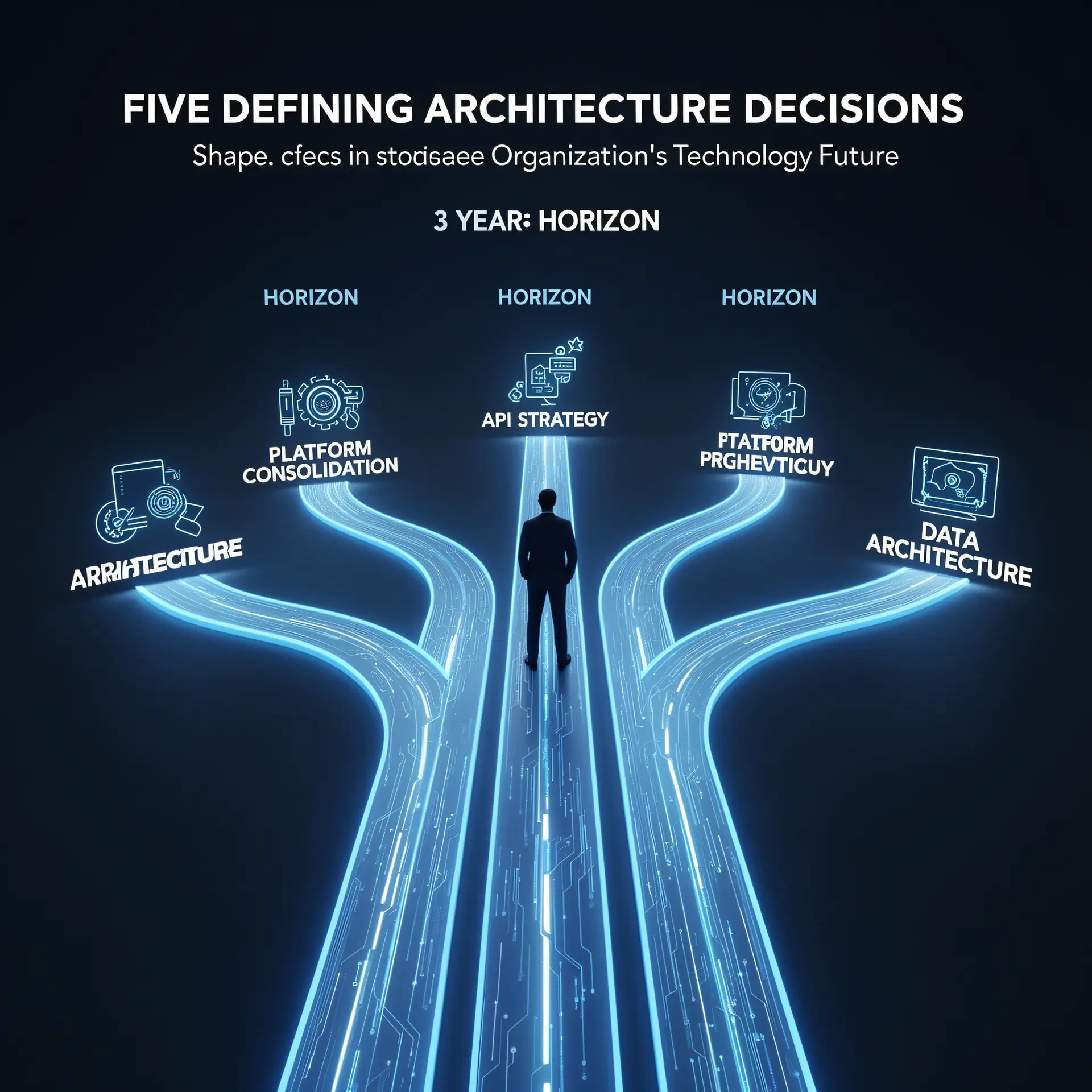
Decision 1: Platform Consolidation vs. Best of Breed
This is the most important call most CTOs face right now. For years, best of breed was gospel. Pick the top tool for every function and build the ultimate stack. The problem is you need deep talent to glue it all together. Security alone shows the strain. Enterprise security teams juggle an average of 76 tools, rising to 96 at companies with 10,000+ employees, per Panaseer’s 2022 Security Leaders Peer Report.
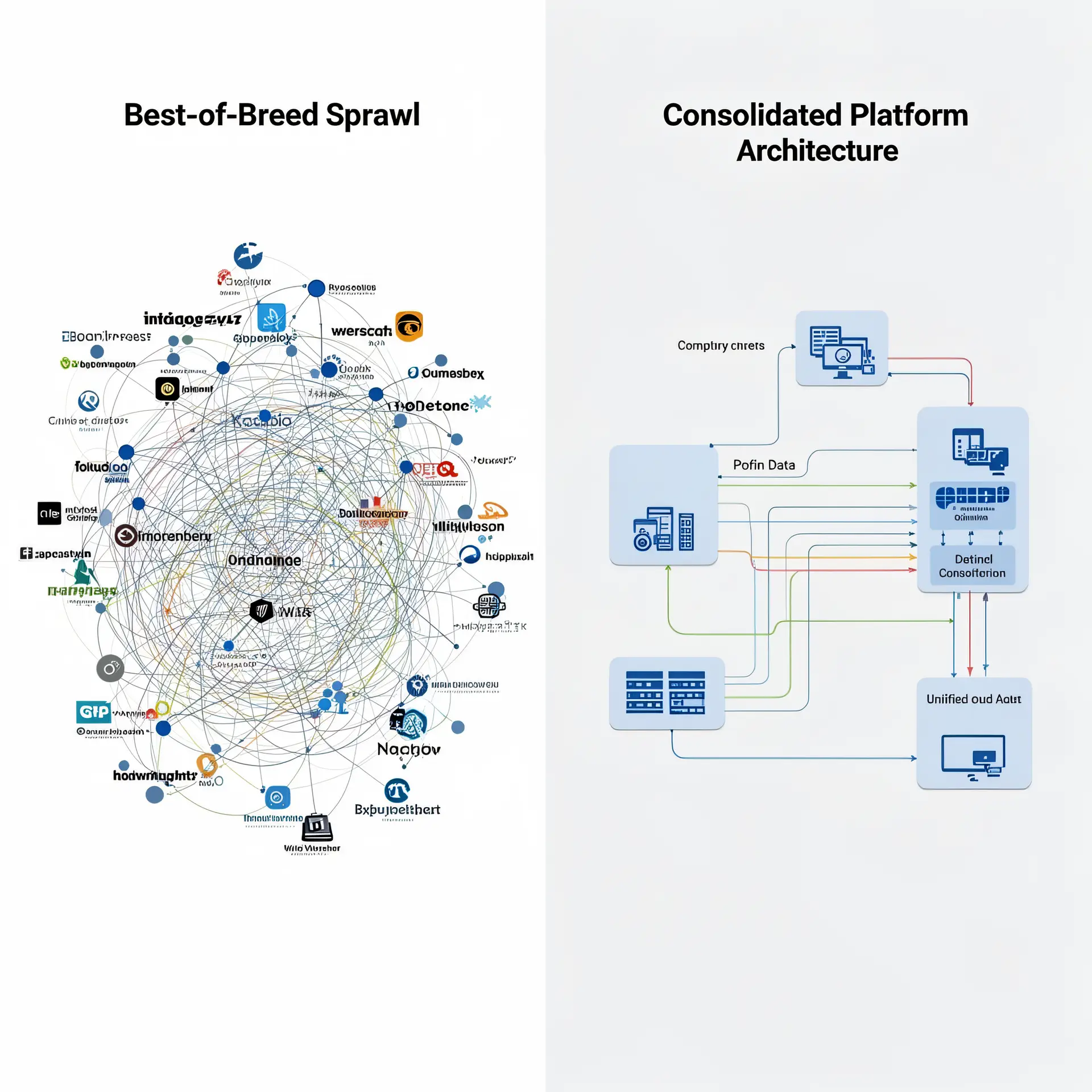
The industry is swinging back toward platforms. Microsoft, AWS, Palo Alto Networks, and ServiceNow all push consolidation hard, and for good reason. Fewer vendors means tighter integration, a smaller attack surface, and simpler operations.
In federal work this matters even more. Every new vendor means FedRAMP reviews, supply chain risk checks, and another ATO package. In my experience, a wrong tool choice in federal costs three to five times what it would in commercial. I push my team to go deep on fewer platforms rather than wide on many.
The hard truth is that best of breed only works if you have the depth to connect it all. Most teams don’t.
Decision 2: API-First vs. Application-First
Here’s a simple test. Ask: “If we need to replace this tool, what breaks?” If the answer is “everything,” you have an application-first design. You bought apps and then stitched them together with fragile point-to-point links.
An API-first approach treats APIs as products, not plumbing. New tools, partners, AI agents, and automation can plug in without a rebuild. Postman’s 2025 State of the API Report found 82% of organizations have adopted some level of API-first, but only 25% are fully API-first. That gap isn’t technical. It’s a leadership gap.
API-first is the default on my team. Every system we build or buy must expose clean, documented APIs. If it doesn’t, it doesn’t get in the door. This one pays off for years.
Decision 3: Data Design: Lakehouse vs. Mesh vs. Chaos
Your AI strategy is really a data strategy wearing a costume. Models are only as good as the data feeding them, and data quality and access are where most AI efforts I see get stuck. I went deeper on this in my post on wrangling enterprise data from sprawl to speed.
You have two main paths. A centralized lakehouse puts data into one unified layer. A data mesh gives ownership to domain teams under shared governance. Neither is always right. Not choosing is always wrong.
Most orgs are stuck in accidental chaos. Some data lives in warehouses. Some hides in SaaS tools. Some lives in spreadsheets. Some exists only in one person’s head. Until you make a deliberate call here, your AI plans will stall.
Decision 4: Identity and Zero Trust as the Base Layer
Identity is the new perimeter. That’s not a hot take anymore. It’s a requirement. OMB M-22-09 pushed federal agencies toward specific zero trust milestones, and commercial firms are following close behind.
Most orgs still treat identity as an IT ops function. It isn’t. It’s a core layer. Your identity provider, your zero trust model, and your conditional access policies cascade into every other choice. Network design, app access, data governance, and automation all depend on identity. I wrote a full executive guide to zero trust if you want the deeper version.
Machine identity for AI agents is now a real concern too. As you deploy more automated workflows, you need to know which agents can reach which data. On my team, identity is decision zero. Nothing else works without it.
Decision 5: AI Model: Embedded vs. Bolt-On vs. Build
Every vendor is shipping “AI-powered” features. The question isn’t whether to use AI. It’s how. You have three models to weigh.
Embedded AI uses features built into your current platforms, like Copilot in Microsoft 365. Low friction, limited control. Bolt-on AI brings in third-party services like the OpenAI or Anthropic APIs. More control, more work. Building means custom models on your own data. High cost, maximum edge.
Most orgs will blend all three. The architecture decision is the ratio. In federal and regulated settings, you also have to think about data sovereignty, the FedRAMP status of AI services, and how controlled data gets handled. Those limits narrow your options fast. Once agents are in the mix, lock down governance before you scale.
Don’t let vendor buzz drive this one. Let your data design and compliance reality guide it.
How to Make Architecture Decisions Stick
Making the call is half the battle. Making it stick is the other half. Three practices help.
Write it down. Use Architecture Decision Records (ADRs). They capture the choice, the context, the trade-offs, and the date. Keep them short and visible. When someone asks “why did we choose this?” you point to the ADR.
Set a review rhythm. I revisit major architecture decisions once a year. Not to second-guess them, but to check whether the context has changed enough to warrant a new call.
Translate for the C-suite. “We’re going from seven security vendors to two” is a sentence a board gets. “We’re building event-driven microservices” is not. Speak in outcomes, not jargon. That’s how you get buy-in and budget.
Architecture Decisions Require Org Change
Conway’s Law is still undefeated. Your systems will mirror your org structure. Siloed teams build siloed systems, and no diagram will change that.
Platform consolidation needs cross-functional platform teams. API-first design needs product-oriented engineering. Data mesh needs domain-level data ownership. These aren’t just technical choices. They’re operating model choices, and the CTO has to co-own them with the COO and CEO.
Leading a 34-person engineering team across networking, security, datacenter, and AI has taught me this directly. The architecture only holds if the org design supports it. Otherwise entropy wins every time.
Stop Buying. Start Deciding.
Every tool you say no to is a tax you don’t pay for three years. Every architecture decision you make is an investment that compounds. Some of the best choices I’ve made were tools I didn’t buy.
So here’s my challenge. Pick one of these five architecture decisions. Make the call this quarter. Write it down. Build from there. Stop solving design problems with procurement. Your future self, and the engineer who has to maintain it all two years from now, will thank you.