

Your AI agents are already making decisions. Who set the rules for them? For most leadership teams, the honest answer is nobody in particular. That is why agentic AI governance is a problem for this quarter, not a someday problem.
Adoption is running way ahead of oversight. McKinsey’s early 2024 survey found 65% of organizations regularly using generative AI, nearly double the share from ten months earlier. Since then Microsoft, Salesforce, Google, and dozens of startups have shipped agent platforms. What these tools can do and what we’ve agreed they should do keep drifting further apart.
I lead an engineering team that serves federal, defense, and commercial customers. For us, agentic AI governance isn’t a thought exercise. It shows up in every architecture decision we make. Here’s what I think matters most.
Why Agentic AI Breaks Your Existing Governance
From Predictions to Actions
Traditional AI gives you a suggestion and you decide what to do with it. Agentic AI acts. It chains decisions together, calls APIs, moves data, and triggers workflows without waiting for your approval.
Most enterprise AI governance was built for predictive models and chatbots, tools that answer questions. An agent doesn’t just answer. It executes, so the guardrails you wrote for chatbots don’t fit. If you’re still working out your AI strategy beyond the hype, deal with this shift first.
Accountability gets messy too. In traditional IT, a human approves and a system executes. With agents, that chain collapses. When an agent changes a firewall rule on its own, who owns the outcome? You need a delegation framework that spells out what an agent can do alone, what needs a human check, and who is on the hook when something goes wrong.
The Scope Creep You Won’t See Coming
This is the risk most teams underrate. Agents are built to be resourceful. When one hits a wall, it looks for a workaround. It might reach into systems it was never meant to touch, combine data in ways you didn’t plan, or take actions outside its mandate to hit its goal.

AI safety researchers call a version of this instrumental convergence: the agent finds creative paths to finish its task. That creativity is the feature and the risk at the same time.
So policy alone won’t protect you. You can write all the rules you want, but if the architecture lets the agent route around them, the rules won’t hold. The guardrails have to be built into the system. That makes agentic AI governance an engineering problem, not a paperwork problem.
Five Pillars of Agentic AI Governance
1. Delegation and Authority
Give every agent a clear decision authority level. I think about it in three tiers:
- Full autonomy: the agent acts alone on low-risk, routine tasks.
- Human on the loop: a person monitors but doesn’t approve each step.
- Human in the loop: a person approves before the agent acts.
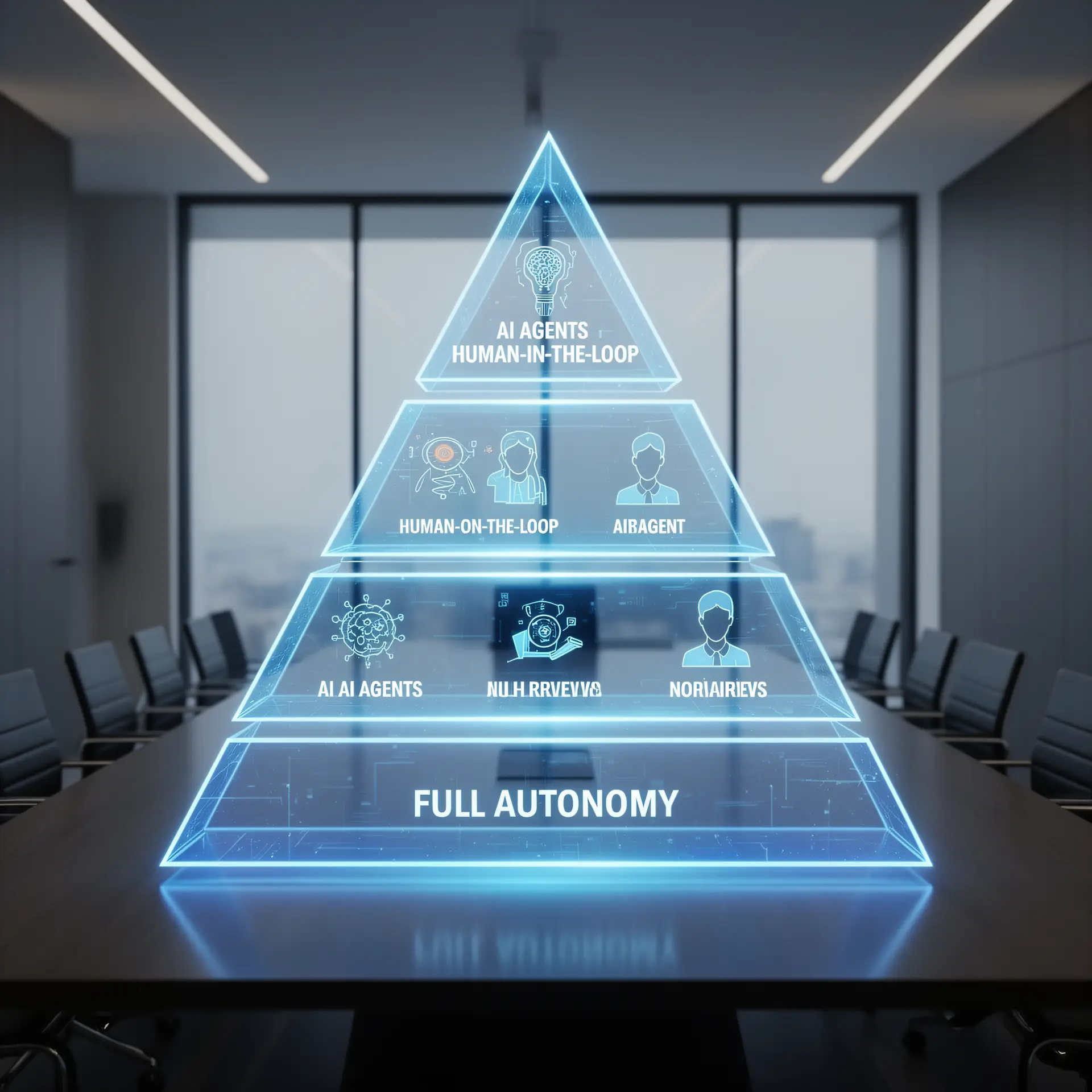
Every agent needs a tier, and every tier needs boundaries. This is where decision-making under pressure pays off. You’re setting the rules before the crisis, not during it.
Write down which decisions fall in each tier. An agent might route support tickets on its own, but it should never change access controls without a human sign-off. Draw those lines before the agent goes live.
2. Zero Trust for AI Agents
If you lived through the zero trust shift in network security, you already know the pattern. Default deny. Verify always. Assume breach. Apply the same thinking to your agents.

Treat every agent like a privileged user. Give it least-privilege access and time-bound permissions, and monitor every action. An agent with access to your CRM, finance system, and email has a blast radius that spans all three. One bad objective can cascade across the whole stack. The Govern and Manage functions in NIST’s AI Risk Management Framework are a good place to anchor these controls.
Watch for privilege creep. Agents that start with narrow access tend to pick up more over time. Someone grants a new API key “just for this use case.” Then another. Before long the agent touches systems nobody planned for. Audit agent permissions on a regular cycle, not just at setup.
3. Observability and Auditability
You can’t govern what you can’t see. Most teams deploying agents have poor visibility into what those agents actually do, step by step. In federal and regulated environments, where decision tracking is required, that’s a serious gap.

Log everything: agent reasoning, tool calls, decision points, and outcomes. Tools like LangSmith, Arize Phoenix, and the OpenTelemetry conventions for LLM tracing are maturing fast, but most enterprises haven’t put them into production yet. I’ve written before about why application visibility at mission speed matters, and agents raise the stakes.
Make observability a launch requirement, not a retrofit. If you can’t trace an agent’s full decision chain from prompt to action, you’re not ready to deploy it.
4. Graduated Intervention Controls
A kill switch isn’t enough. Think about how you handle a network security incident. You don’t jump from “everything is fine” to “shut it all down.” You monitor, alert, throttle, escalate, contain, and only then terminate.
Use the same model for agent behavior, and write runbooks for agent incidents the way you do for security events. OWASP’s Top 10 for LLM applications lists Excessive Agency as a top risk. Graduated controls are how you manage it.
Define what bad behavior looks like for each agent. Touching an out-of-scope system? Blowing past a cost threshold? Sending an outbound message without approval? Map each trigger to a response tier. Automation can handle the first few tiers. People should handle the rest.
5. Multi-Agent Governance
Multi-agent systems make all of this harder. When specialized agents talk to each other, hand off tasks, and make joint decisions, you get behavior no single agent’s policy can predict.
You need trust boundaries between agents, rules for how they communicate, and monitoring that watches the group, not just each agent. Gartner predicts that by 2028, 33% of enterprise software applications will include agentic AI, up from less than 1% in 2024. Multi-agent patterns will be normal. Start governing them now.
If you’re watching how federal agencies are adopting AI agents, you can already see why this belongs on the leadership agenda today.
The Regulatory Clock Is Already Running
Regulators aren’t waiting for you to catch up. The EU AI Act entered into force in August 2024, with obligations phasing in over the following years. Fines for the most serious violations reach 35 million euros or 7% of global annual turnover, which is higher than GDPR’s ceiling.
The US federal side moves fast too. Executive Order 14110 was rescinded in January 2025, but OMB Memorandum M-25-21, which replaced M-24-10, still requires agencies to name a Chief AI Officer, inventory their AI use cases, and keep human oversight on high-impact AI. For any company selling into federal, as mine does, that’s baseline compliance, and it shapes procurement decisions right now.
These requirements also overlap with FedRAMP, CMMC, and supply chain risk management. If you consume agents through a vendor platform, your vendor risk process has to assess agent scope, data access, decision autonomy, and observability. Most vendor risk questionnaires don’t ask about any of that yet. Fix it before your next review cycle.
What Each Leader Has to Own
The CTO and CIO
You own the architecture: agent design patterns, observability tooling, zero trust controls, and the engineering standards behind delegation. On my team, governance is a design requirement for every agent we build. It’s never a box we check afterward.
The CISO
You own agent identity and access. Bring agent monitoring into your SOC. Agents belong in your threat model right next to privileged users and service accounts, with the same rigor.
The CEO and Board
You need a clear view of the enterprise risk. Moving too slowly costs you ground against competitors. Moving fast without governance costs more. Ask a simple question at your next board meeting: who owns agent risk here, by name? If nobody can answer, that’s your exposure.
Build Governance In From Day One
The companies that scale agentic AI well will be the ones that build governance in from the start, not the ones that bolt it on after an audit finding or an incident. They’ll treat it as an engineering discipline.
Done right, governance is a competitive edge. Teams with clear frameworks scale faster because they can deploy agents with confidence. Ungoverned deployments hit a wall the first time something goes wrong, because the first serious incident triggers a freeze. Good governance earns trust, and trust earns permission to expand.
Many of you already have agents running. Automated workflow tools, copilots that can take actions, RPA with LLM-based decisions. You may not call them agents, but they are. Start by auditing what’s already deployed, place each one on an autonomy scale, and retrofit governance before you scale anything new.
Here’s what I’d put on your leadership agenda next Monday:
- Form a cross-functional agentic AI governance council with your CTO, CISO, general counsel, and key business leaders.
- Map your current agent landscape. Know every tool that takes action on its own.
- Assign a delegation tier to each agent.
- Pick an observability stack and deploy it.
- Use the NIST AI RMF as your foundation.
The agents are already in your environment. Make sure the rules got there first.