

In the world of computing, a new era is dawning – the age of quantum computing. This revolutionary technology promises to solve problems that are currently intractable for classical computers, opening up new possibilities in fields ranging from drug discovery to artificial intelligence. Recently, Google made headlines by claiming to have achieved quantum supremacy, a milestone that marks the beginning of this exciting new chapter in computing history.
The implications of this breakthrough extend far beyond academic laboratories. Major corporations, governments, and research institutions worldwide are investing billions of dollars into quantum computing research, recognizing its potential to revolutionize everything from financial modeling to climate prediction. The global quantum computing market, valued at approximately $1.3 billion in 2024, is projected to reach $5.3 billion by 2029, according to recent market analysis.
What is Quantum Computing?
Quantum computing leverages the principles of quantum mechanics to perform complex computations. Unlike classical computers, which rely on bits that can be either 0 or 1, quantum computers use qubits (quantum bits) that can exist in multiple states simultaneously, a phenomenon known as superposition. This allows quantum computers to perform certain calculations exponentially faster than their classical counterparts.
To understand the fundamental difference, consider that a classical computer with n bits can be in exactly one of 2^n possible states at any given time. In contrast, a quantum computer with n qubits can be in a superposition of all 2^n states simultaneously. This exponential scaling is what gives quantum computers their theoretical advantage for certain types of problems.
Beyond superposition, quantum computers exploit two other critical quantum phenomena:
Entanglement: When qubits become entangled, the state of one qubit becomes intrinsically linked to another, regardless of the physical distance between them. This phenomenon, which Einstein famously called “spooky action at a distance,” allows quantum computers to perform correlated operations on multiple qubits simultaneously. Measuring one entangled qubit instantly affects its entangled partners, enabling quantum computers to process information in ways classical computers cannot replicate.
Quantum Interference: This principle allows quantum computers to amplify correct answers and cancel out wrong ones through constructive and destructive interference patterns. By carefully orchestrating these interference patterns, quantum algorithms can guide the system toward the correct solution with high probability.
The power of quantum computing lies in its ability to solve problems that are intractable for classical computers. Specifically, quantum computers excel at:
- Simulating complex chemical reactions: Quantum computers can naturally model quantum mechanical systems, making them ideal for simulating molecular interactions, protein folding, and catalyst design
- Optimizing complex systems: From supply chain logistics to financial portfolio optimization, quantum algorithms can explore vast solution spaces more efficiently
- Accelerating machine learning: Quantum machine learning algorithms can potentially speed up training times and improve pattern recognition in high-dimensional data
- Cryptanalysis: Certain quantum algorithms can break widely-used encryption schemes, necessitating the development of quantum-resistant cryptography
The Technical Architecture of Quantum Processors
Modern quantum processors require extraordinary engineering to maintain quantum coherence. Most superconducting quantum computers, like Google’s Sycamore, operate at temperatures near absolute zero (approximately 15 millikelvin), colder than outer space. This extreme cooling is necessary to minimize thermal noise that would otherwise destroy the delicate quantum states.
The physical implementation of qubits varies across different approaches:
Superconducting Qubits: Used by Google, IBM, and Rigetti, these rely on Josephson junctions – thin insulating barriers between superconductors. Current flowing through these junctions can exist in superposition states, forming the basis for quantum computation.
Trapped Ion Qubits: Companies like IonQ and Honeywell use individual ions confined by electromagnetic fields. These systems offer excellent coherence times and high-fidelity operations but face challenges in scaling to large numbers of qubits.
Topological Qubits: Microsoft is pursuing this approach, which promises inherent error resistance through topological protection, though practical implementation remains elusive.
Photonic Qubits: Companies like Xanadu and PsiQuantum use photons as qubits, offering room-temperature operation and easy integration with existing fiber optic infrastructure.
Google’s Quantum Supremacy Claim
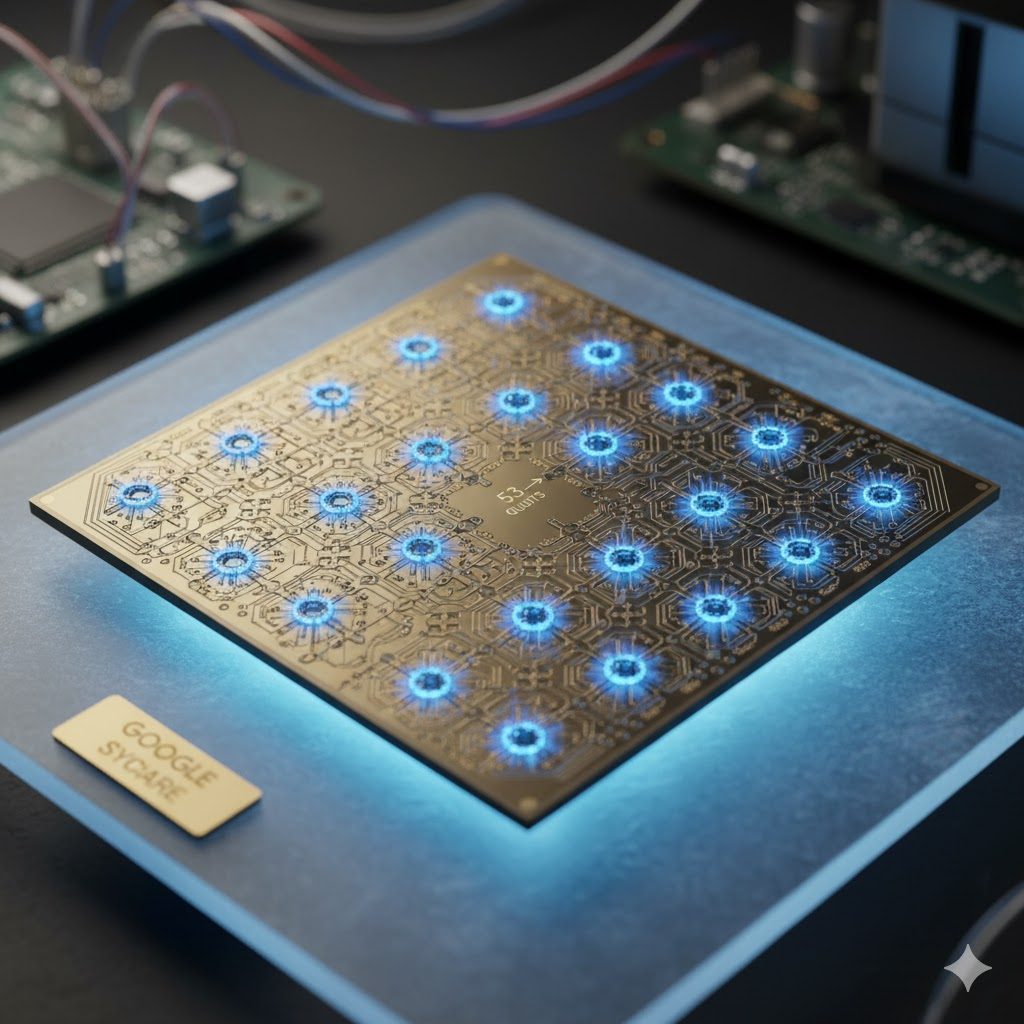
In October 2019, Google announced that its quantum processor, named Sycamore, had achieved quantum supremacy by performing a calculation in just 200 seconds that would take the world’s most powerful supercomputer 10,000 years to complete. This calculation involved sampling from the output distribution of a random quantum circuit, a task specifically chosen to highlight the advantages of quantum computation.
The Sycamore processor contains 53 functional qubits (originally designed for 54, but one was non-operational) arranged in a two-dimensional grid. Each qubit can interact with up to four neighbors, allowing for complex entanglement patterns. The specific benchmark task involved:
- Preparing a highly entangled quantum state through a sequence of random single- and two-qubit gates
- Measuring all qubits to obtain a bitstring output
- Repeating this process millions of times to build a probability distribution
- Verifying that this distribution matches theoretical predictions using cross-entropy benchmarking
Google’s claim sparked immediate controversy. IBM, a major competitor, argued that their classical supercomputer could perform the same calculation in 2.5 days rather than 10,000 years by using different algorithmic approaches and leveraging both RAM and disk storage. This dispute highlighted the subjective nature of quantum supremacy claims and the importance of careful benchmark selection.
The Technical Challenges of Quantum Error Correction
One of the most significant obstacles to practical quantum computing is quantum decoherence – the tendency of quantum systems to lose their quantum properties through interaction with the environment. Current quantum processors suffer from error rates of approximately 0.1-1% per operation, compared to classical computers with error rates below 10^-17.
Quantum error correction requires significant overhead. The surface code, one of the most promising error correction schemes, requires approximately 1,000 physical qubits to create one logical qubit with sufficiently low error rates for practical computation. This means that solving real-world problems might require millions of physical qubits, far beyond current capabilities.
Researchers are pursuing multiple strategies to address this challenge:
- Improved qubit designs with longer coherence times
- Better isolation from environmental noise
- Novel error correction codes with lower overhead
- Quantum error mitigation techniques that work with noisy intermediate-scale quantum (NISQ) devices
The Race for Quantum Supremacy

Google is not alone in the race for quantum supremacy. The competitive landscape includes:
IBM: With their IBM Quantum Network comprising over 200 members, IBM has made quantum computing accessible through cloud services. Their roadmap targets 100,000-qubit systems by 2033, utilizing a modular approach with quantum communication links between processors.
Microsoft: Focusing on topological qubits through their Azure Quantum platform, Microsoft aims to achieve superior error rates, though they have yet to demonstrate a working topological qubit.
Amazon: Through AWS Braket, Amazon provides cloud access to various quantum hardware platforms while developing their own quantum processor at the Center for Quantum Computing at Caltech.
Intel: Pursuing both superconducting and spin qubit approaches, Intel leverages its semiconductor fabrication expertise to potentially mass-produce quantum chips.
Chinese Research Institutions: The University of Science and Technology of China has demonstrated quantum supremacy with their photonic quantum computer Jiuzhang and superconducting processor Zuchongzhi.
Startups are also making significant contributions:
- Rigetti Computing: Developing full-stack quantum computing systems and hybrid classical-quantum algorithms
- IonQ: Creating trapped ion systems with industry-leading gate fidelities
- PsiQuantum: Building utility-scale photonic quantum computers with millions of qubits
- Quantum Brilliance: Developing room-temperature diamond-based quantum accelerators
Real-World Applications and Industry Impact
The potential applications of quantum computing extend across numerous industries:
Drug Discovery and Healthcare: Quantum computers can simulate protein folding and molecular interactions with unprecedented accuracy. Companies like Roche and Merck are partnering with quantum computing firms to accelerate drug discovery. Menten AI and IBM have already demonstrated quantum-enhanced drug discovery algorithms that identified potential COVID-19 treatments.
Financial Services: JP Morgan Chase, Goldman Sachs, and other financial institutions are exploring quantum algorithms for:
- Portfolio optimization
- Risk analysis
- Fraud detection
- High-frequency trading strategies
- Derivative pricing
Materials Science: Quantum simulations can predict properties of new materials for batteries, solar cells, and superconductors. Volkswagen and Daimler are using quantum computing to design better battery chemistry for electric vehicles.
Artificial Intelligence: Quantum machine learning algorithms promise advantages in:
- Feature mapping in high-dimensional spaces
- Optimization of neural network architectures
- Speeding up training for certain model types
- Solving combinatorial optimization problems in AI
Supply Chain and Logistics: Companies like D-Wave have demonstrated quantum optimization for:
- Route optimization for delivery services
- Supply chain management
- Traffic flow optimization
- Resource allocation
The Quantum Software Stack
Developing quantum algorithms requires a completely different approach than classical programming. The quantum software stack includes:
Quantum Programming Languages:
- Qiskit (IBM): Open-source SDK for working with quantum computers
- Cirq (Google): Python library for writing, manipulating, and optimizing quantum circuits
- Q# (Microsoft): Domain-specific language designed for quantum computing
- Forest (Rigetti): Quantum development platform including the Quil instruction language
Quantum Algorithms: Several fundamental quantum algorithms demonstrate quantum advantage:
- Shor’s Algorithm: Factors large integers exponentially faster than known classical algorithms
- Grover’s Algorithm: Searches unsorted databases with quadratic speedup
- Quantum Approximate Optimization Algorithm (QAOA): Solves combinatorial optimization problems
- Variational Quantum Eigensolver (VQE): Finds ground states of molecular Hamiltonians
The Future of Quantum Computing
Suggested Image: A timeline visualization showing the evolution from current NISQ devices to fault-tolerant quantum computers, with milestone markers for qubit counts and error rates
The roadmap to practical quantum computing involves several key milestones:
Near-term (2024-2027):
- NISQ devices with 100-1,000 qubits
- Demonstration of quantum advantage for commercially relevant problems
- Improved error mitigation techniques
- Hybrid classical-quantum algorithms becoming standard
Medium-term (2027-2035):
- Early fault-tolerant systems with logical qubits
- Quantum advantage for specific industry applications
- Standardization of quantum programming languages and tools
- Quantum cloud services becoming mainstream
Long-term (2035+):
- Large-scale fault-tolerant quantum computers
- Quantum advantage for broad problem classes
- Integration with classical HPC systems
- Potential for quantum artificial general intelligence
Challenges and Considerations
Despite rapid progress, significant challenges remain:
Technical Challenges:
- Scaling qubit counts while maintaining quality
- Achieving error rates necessary for fault tolerance
- Developing efficient quantum algorithms for real problems
- Creating better quantum-classical interfaces
Practical Challenges:
- Cost of quantum systems (current systems cost millions of dollars)
- Requirement for specialized expertise
- Limited availability of quantum hardware
- Need for new software development paradigms
Security Implications: The advent of large-scale quantum computers threatens current cryptographic systems. Organizations must begin transitioning to post-quantum cryptography now, as “harvest now, decrypt later” attacks pose immediate risks.
Conclusion
Google’s achievement of quantum supremacy represents a watershed moment in computing history, comparable to the first electronic computers or the invention of the transistor. While the specific problem solved may seem esoteric, it proves that quantum computers can outperform classical systems for certain tasks – a proof of principle that opens the door to revolutionary applications.
The race for quantum supremacy has evolved into a race for quantum advantage – the point where quantum computers solve practical problems better than classical alternatives. As investment pours in from both public and private sectors, and as technical challenges are gradually overcome, we stand on the brink of a quantum revolution that will reshape computing, science, and society.
The journey from today’s noisy intermediate-scale quantum devices to fault-tolerant quantum computers will require continued innovation, collaboration, and investment. Yet the potential rewards – from life-saving drugs to revolutionary materials to unprecedented computational capabilities – make this one of the most exciting frontiers in modern technology. The quantum age has begun, and its full impact is yet to be imagined.
Sources:
Official Resources:
- Google AI Quantum – Google’s official quantum computing research page
- IBM Quantum Network – IBM’s quantum computing platform
- Microsoft Azure Quantum – Microsoft’s quantum development platform
- AWS Braket – Amazon’s quantum computing service
Research Papers and Publications:
- Nature: Quantum supremacy using a programmable superconducting processor – Google’s original quantum supremacy paper
- arXiv.org Quantum Computing Papers – Latest quantum computing research
- Physical Review Letters – Leading physics journal with quantum research
Industry Analysis:
- MIT Technology Review Quantum Computing – In-depth quantum computing coverage
- Quantum Computing Report – Industry news and analysis
- IDC Quantum Computing Market Analysis – Market research and projections
Educational Resources:
- Qiskit Textbook – Comprehensive quantum computing education
- Microsoft Quantum Development Kit – Q# documentation and tutorials
- Nielsen & Chuang “Quantum Computation and Quantum Information” – The definitive textbook
Standards and Organizations:
- Quantum Economic Development Consortium (QED-C) – Industry consortium
- National Institute of Standards and Technology (NIST) – Quantum standards and research