Most of your AI pilots are dead. They just haven’t been buried yet. Your team built a great demo 18 months ago. Leadership clapped. A slide deck made the rounds. Then nothing happened. The pilot sat there burning budget while everyone moved on to the next shiny thing.
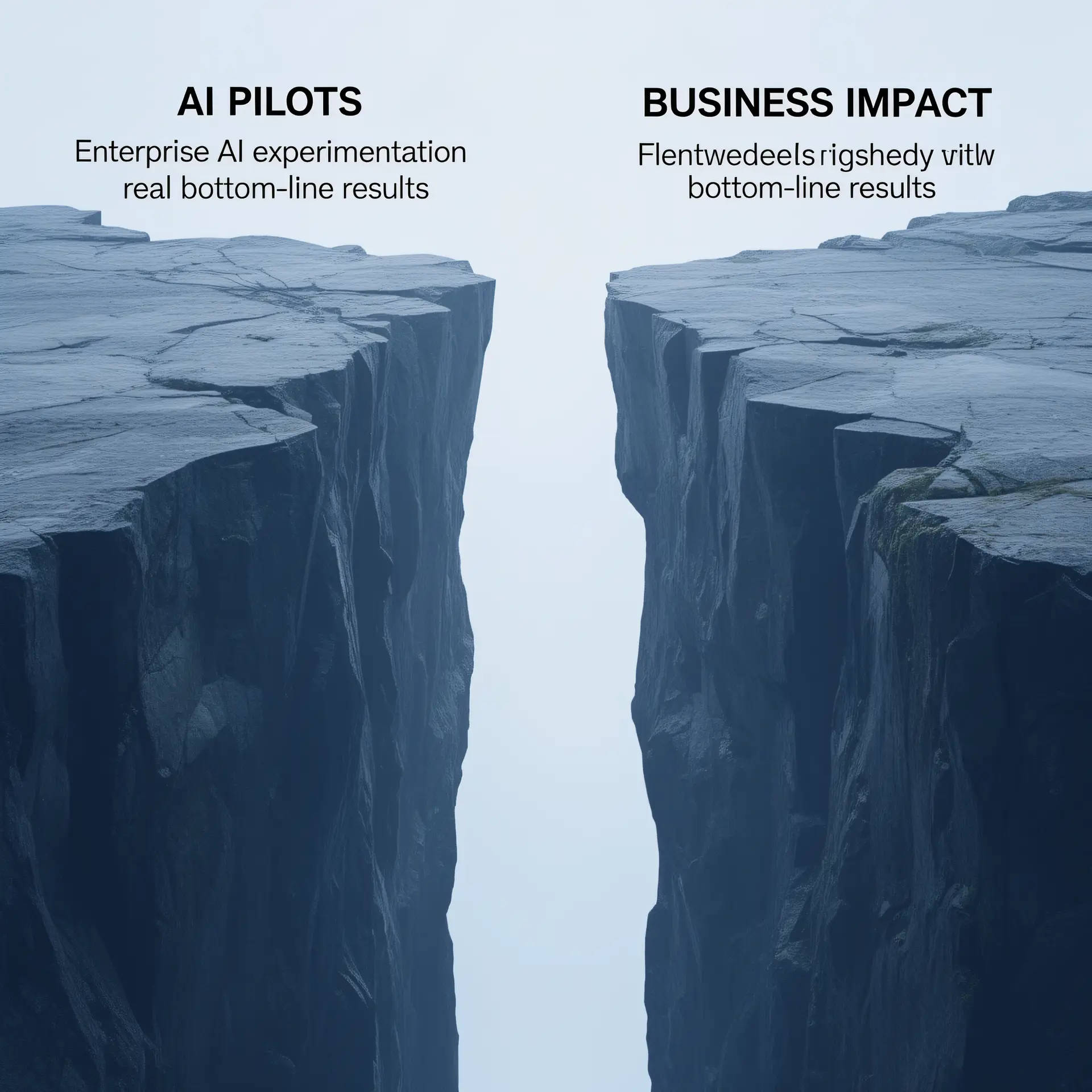
If that sounds familiar, you’re not alone. McKinsey’s State of AI research found that 72% of organizations had adopted AI in at least one business function by early 2024. Adoption isn’t impact, though. Plenty of those companies are still waiting for the work to show up on the P&L. 2026 is the year you close that gap or fall behind, and closing it means moving from AI pilots to a real AI-native operating model.
Pilot Purgatory: Why Most AI Projects Stall
I see the same pattern over and over. A team builds a proof of concept. It works great in a sandbox. Leadership gets excited. Then reality hits. The data isn’t clean. The infrastructure can’t handle production loads. Nobody owns the workflow change. There’s no path to scale.

Gartner saw this coming. In July 2024 it predicted that at least 30% of generative AI projects would be abandoned after proof of concept by the end of 2025, citing poor data quality, weak risk controls, rising costs, and unclear business value. None of those are technology failures. They’re leadership failures. We keep funding experiments without committing to the hard work of making them real.
Pilot purgatory costs more than budget. It costs trust. Your engineers stop believing AI work matters. Your business leaders stop believing IT can deliver. And every failed pilot makes the next one harder to fund.
So the first step toward an AI-native operating model is honest triage. Look at every AI effort you’re running and ask three questions:
- Does it solve a real business problem?
- Can the data support production use?
- Does the organization actually want to change how it works?
If the answer to any of those is no, kill it and free up the people and budget. A bias toward action sometimes means having the nerve to stop.
What an AI-Native Operating Model Actually Means
“AI-native” doesn’t mean using more AI tools. It means redesigning how the company runs with AI as a core participant. Think back to the cloud-native shift. Companies didn’t just move servers to AWS. They rebuilt apps, changed deployment models, and retooled teams. The same thing is happening with AI now.
AI-Enhanced vs. AI-Native
An AI-enhanced company bolts a chatbot onto existing workflows. An AI-native company redesigns the workflow. AI handles the routine work. Humans handle the judgment calls.
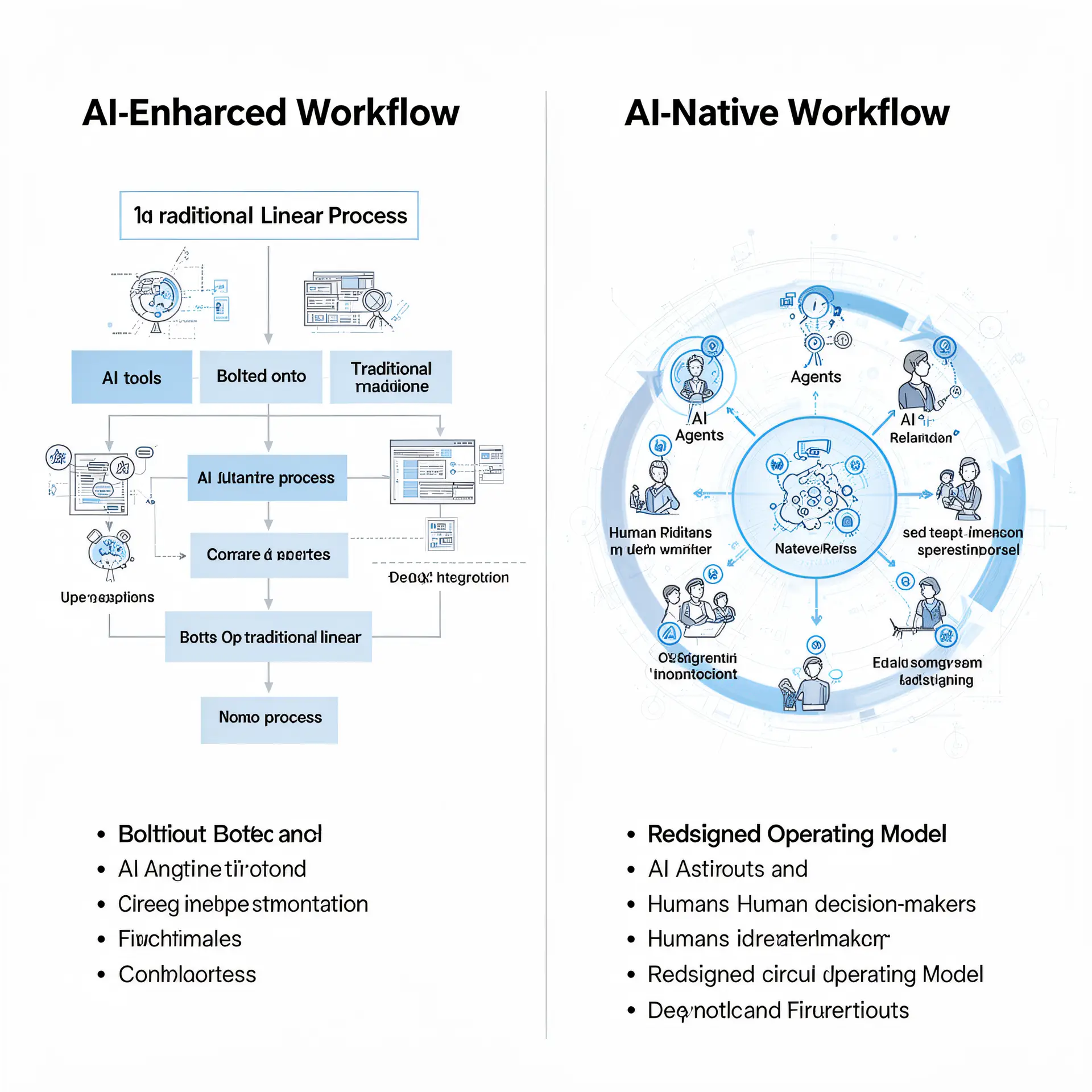
Take security operations. In an AI-enhanced SOC, analysts use AI to summarize alerts. In an AI-native SOC, AI agents triage, correlate, and respond to low-level threats on their own, and humans step in for the complex decisions. That’s a very different architecture.
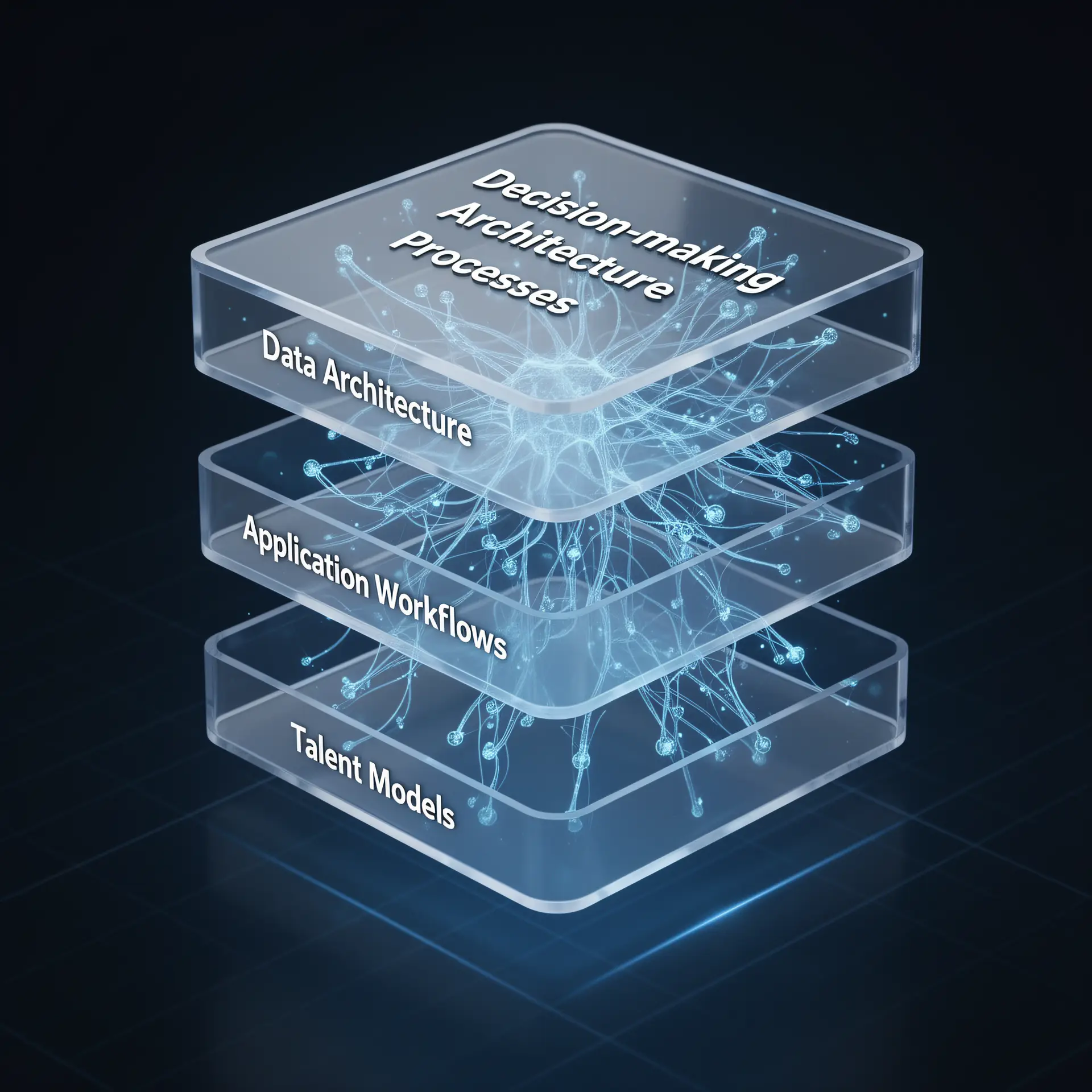
An AI-native operating model touches four layers: decision-making processes, data architecture, application workflows, and talent models. You can’t change one and leave the others alone. They move together, which makes this a C-suite conversation, not an IT project. I’ve written before about how to move AI strategy beyond the hype if you want more on that.
The Enterprise Architecture Reset
Fix the Data Foundation First
Nobody gets promoted for fixing data governance. But you can’t run AI at scale on fragmented, siloed, ungoverned data.
Gartner’s numbers back this up. In a February 2025 release, it reported that 63% of organizations either don’t have or aren’t sure they have the right data management practices for AI. It also predicted that through 2026, organizations will abandon 60% of AI projects that aren’t supported by AI-ready data.
Before you deploy another model, do the unglamorous work. Set up lineage tracking. Assign clear data ownership. Define quality standards. Build the pipelines your AI workloads need. I’ve covered this in detail in my post on wrangling enterprise data. Everything else sits on this foundation. Skip it and you’re building on sand.
Architect for Agentic AI
The conversation is moving fast from copilots to agents. Copilots assist people. Agents act on their own within defined boundaries. That changes how you design systems.
Agents need well-defined APIs. They need guardrails that keep them inside their authority. They need full observability so you can see what they did and why. Most enterprises don’t have any of this today.
The trust framework for autonomous systems is still taking shape, too. You need clear policies on what an agent can decide alone and when it has to escalate to a human. Get that wrong and you’ve built a compliance problem. I went deeper on this in agentic AI governance and in my piece on AI agents in federal agencies.
Co-Design Security from Day One
An AI-native operating model opens new attack surfaces: prompt injection, model poisoning, data leakage through inference, and shadow AI nobody approved. These are real threats, not theory.
For those of us serving federal customers, it gets more complex. You’re working within FedRAMP, CMMC, the NIST AI Risk Management Framework, and OMB’s AI governance memo, M-25-21. Security can’t be bolted on later. It has to be designed into the architecture from the start.
I’d argue that complexity is a competitive edge. Companies that learn to deliver AI-native solutions inside those constraints will own a market that well-funded but compliance-naive competitors can’t easily enter.
The Human Side of the Change
This is where I spend most of my time as a CTO. The technology is the easier part. Leading people through this kind of change is much harder.
When you move to an AI-native operating model, roles shift. Engineers start orchestrating AI systems. Analysts become validators of AI output. Some middle management layers face hard questions about their purpose.
I lead a team of 34 engineers. When we go through big shifts, people get nervous. They wonder whether their skills still matter. The most useful thing I can do is give honest direction without false certainty. I tell my team what I know, what I don’t know, and what we’re going to figure out together.
That’s servant leadership in practice. You don’t need all the answers. You need to make it safe for your people to do their best work while things are uncertain.
Reskilling at Speed
Reskilling has to happen fast. PwC’s 27th Annual Global CEO Survey found that 69% of CEOs expect generative AI to require most of their workforce to build new skills within three years. You can’t hire your way out of that. You have to develop the talent you already have. I wrote about this in my post on upskilling federal teams in AI, and the same lessons apply in the commercial sector.
New Cost Models Your CFO Needs to Understand
AI at scale brings a cost structure most finance teams aren’t ready for. Traditional software runs on predictable SaaS licensing. An AI-native operating model runs on inference compute, which is variable and sometimes hard to forecast.
GPU usage, model hosting, and fine-tuning cycles don’t fit neatly into existing CapEx and OpEx buckets. The good news is that unit costs are falling fast. Stanford’s 2025 AI Index found that the cost of running a model at GPT-3.5 level dropped more than 280-fold between November 2022 and October 2024. Cheaper tokens don’t mean a smaller bill, though. Usage grows to fill the savings.
That’s why you need a new financial frame. I call it Total Cost of AI Ownership: compute, data prep, governance, security, talent, and ongoing model management. Your CFO needs that full view. Without it, AI spending looks like a black hole. My AI ROI scorecard is a good place to start.
A Four-Quarter Roadmap
Here’s how I’d approach the architecture reset if I started the clock today.
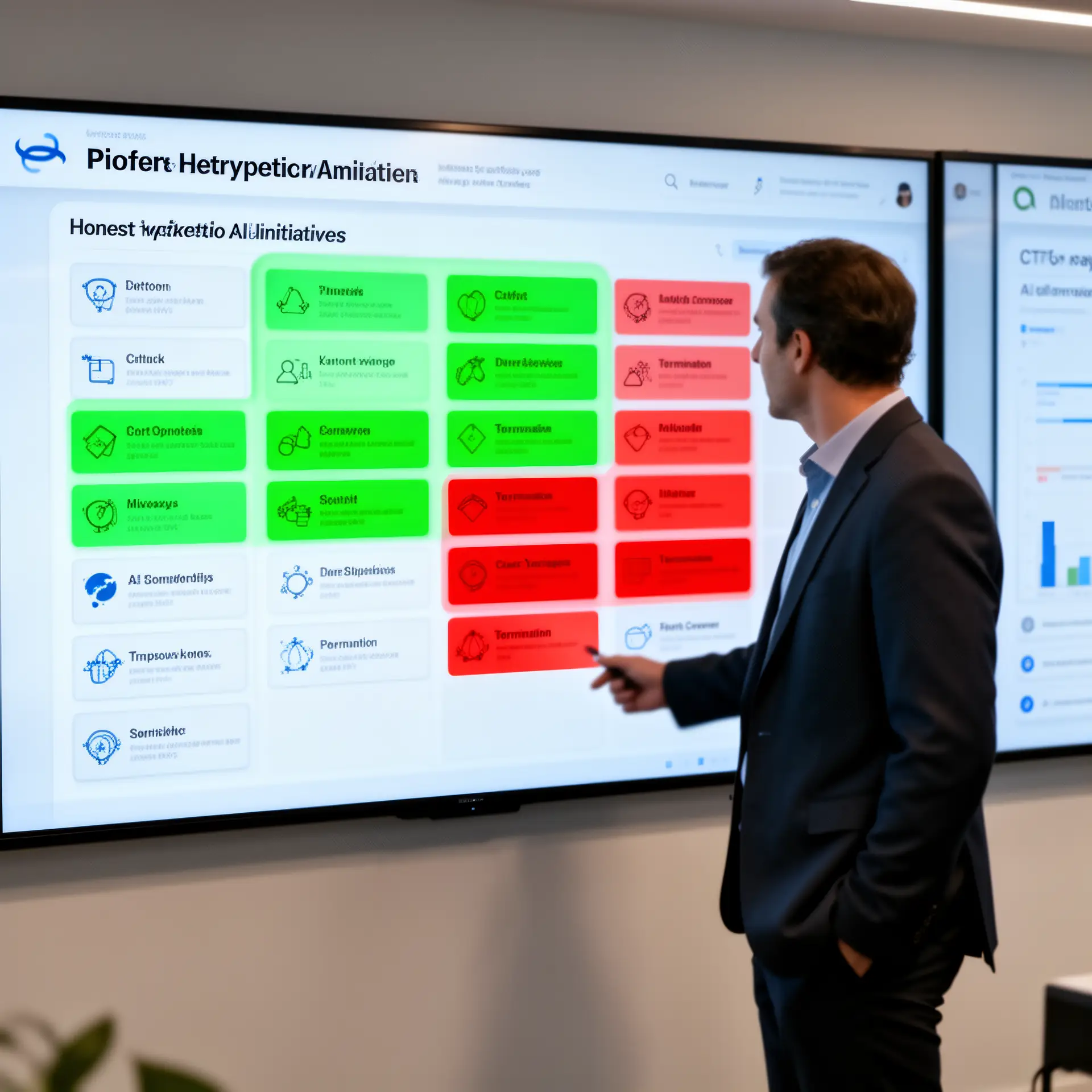
Q1: Audit and commit. Kill the dead pilots. Assess your data maturity honestly. Pick two or three use cases with clear business value and a real path to production. Get C-suite alignment on direction and budget.
Q2: Data foundation sprint. Fix governance. Set data quality standards. Build the pipelines your AI workloads need. This quarter feels slow. It’s the most important one.
Q3: Architecture and security. Deploy agent frameworks with proper guardrails. Build observability. Co-design security controls. Start reskilling programs for your engineering teams.
Q4: Scale and measure. Put your first AI-native workflows into production. Measure outcomes against clear baselines. Iterate. Share the results with the board.
The C-Suite Has to Own This Together
AI strategy is no longer something the CTO owns alone. In that same PwC survey, 70% of CEOs said generative AI will significantly change how their company creates, delivers, and captures value within three years. If the business model is changing, the CEO, CFO, COO, and CTO have to co-own the transition. For a CTO’s view of the architecture decisions that come with it, start there.
Boards are asking pointed questions. Competitors who moved early are starting to show results. The window for “exploring AI” has closed.
2026 is about committing to an AI-native operating model and executing with discipline. This is the biggest shift since cloud. Make the hard calls. Fix the foundation. Lead your people through the uncertainty. Then build something that actually works.