Your brain is the most important system you run, and most executives run it with no monitoring at all. We track uptime on servers. We measure latency on networks. Then we ignore the one system behind every major decision. That system is your cognitive endurance, and in an always-on AI workday it wears down faster than you think.
AI hasn’t made the job lighter. Microsoft’s 2024 Work Trend Index found 75% of knowledge workers already use AI at work, yet 68% say they struggle with the pace and volume of their work and 46% feel burned out. The tools are faster. The decisions still need a human, and they land on your desk at a pace your brain was never built for. Cognitive endurance isn’t a wellness buzzword. It’s a leadership KPI, so treat it like one.
The Neuroscience Behind Cognitive Endurance Decline
Fatigue isn’t just a feeling. It’s chemistry. A 2022 study from the Paris Brain Institute found that long stretches of hard mental work cause glutamate to build up in the prefrontal cortex, the part of the brain that handles judgment, planning, and impulse control.
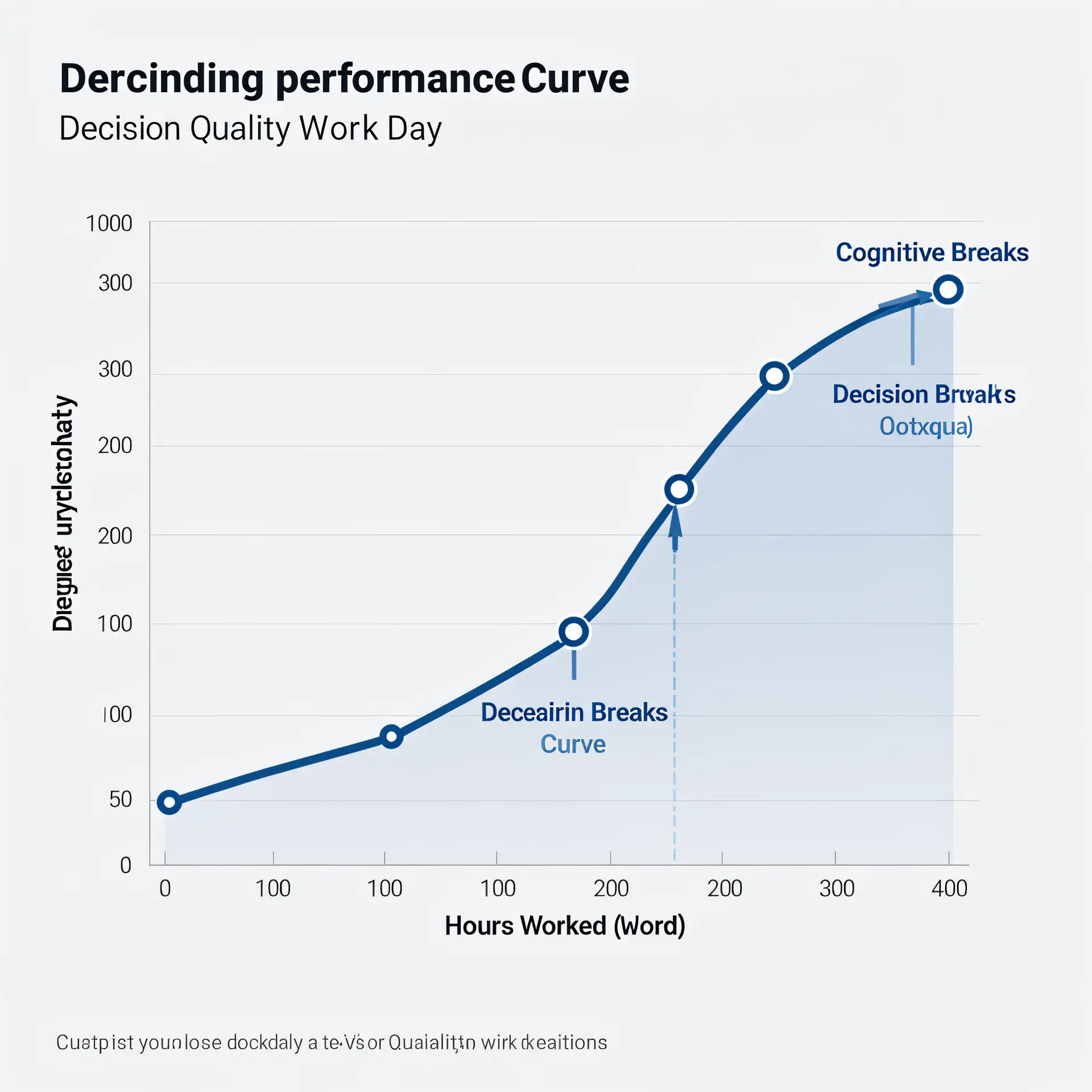
So the functions you need most as a leader are the first to slip. This isn’t about willpower. A sharp executive making calls in hour ten is measurably worse at it than the same person in hour two. You’d never let a tired engineer push untested code to production at midnight. Why do we let worn-out leaders make strategic calls at 4 PM on a Thursday?

Decision Fatigue Is Real and Predictable
In a well-known PNAS study of parole hearings, judges granted parole about 65% of the time early in a session. By the end of a session the rate fell to nearly zero. After a food break, it jumped back up. The judges had no idea. They believed they were being consistent.
Executives ride the same curve, and most never plan their days around it. The riskiest decisions are the ones you make when you think you’re fine. Awareness won’t fix that. You need a system. I go deeper on this in my guide to executive decision making under pressure.
The AI Paradox: More Tools, More Cognitive Tax
Old-school burnout came from task volume. The new fatigue comes from constant switching between AI outputs that all want your judgment. You review an AI-drafted strategy. Then you check an AI-flagged issue. Then you pick between three AI-ranked options. Each one is a mental gear shift.
Microsoft’s 2025 telemetry found employees are interrupted every two minutes during core hours by a meeting, email, or chat, about 275 times a day. For an executive, a lot of those interruptions carry real stakes. The idea that AI makes things easier is a half-truth. AI makes data faster. It makes judgment harder.

I lead an engineering team across networking, security, datacenter, and AI. Every day our tools surface insights across all of those areas, and each one needs a person to review it in context. The bottleneck is never the data. It’s my ability to think clearly about it. In this role, cognitive endurance matters more than raw intelligence. If you want the strategy side of this, read AI for business leaders: strategy beyond the hype.
Engineer Your Day Like You’d Engineer a System
If you ran a data center the way most executives run their calendars, you’d be fired. No load balancing. No maintenance windows. No monitoring. Just maximum throughput until something breaks. Then we wonder why our judgment slips.
Calendar design is one of the most underused tools for protecting cognitive endurance. Here’s what it looks like in practice.
Batch Your Decisions by Type
Don’t mix day-to-day calls with strategic ones. Daniel Kahneman described two modes of thinking: fast and intuitive (System 1) and slow and deliberate (System 2). Bouncing between them all day drains you. Group your tactical calls in one block and protect a separate block for big-picture thinking.
Protect Your Peak Window
Most people do their sharpest thinking in the first few hours after they wake up, and focus fades after a few hours of sustained effort. I put my hardest decisions and most important reviews in the morning and guard that window like a production system. No meetings that could have been an email. No low-value interruptions.
Use AI to Offload, Not Overload
The best thing I’ve done with AI isn’t doing more. It’s deciding better. I use it to pre-filter, summarize, and rank information so I spend judgment only where it counts. Ask yourself whether you’re using AI to raise your volume or protect your quality. Most leaders default to volume. That’s the trap.
The Physical Layer: Why Your Workout Builds Cognitive Endurance
This part I know firsthand. I lost a lot of weight through steady training while running a demanding tech org. I didn’t do it for vanity. I kept noticing that on days I trained, my judgment was sharper, my patience lasted longer, and I could hold complex problems in my head deeper into the afternoon.
The research lines up with that. Studies consistently link regular aerobic exercise to better executive function, and Harvard Health points to exercise raising BDNF, a protein that supports brain cell health and growth, including in regions tied to thinking and memory.
Your morning workout isn’t self-care. It’s maintenance on your most critical system. Sleep works the same way. In Why We Sleep, Matthew Walker cites research showing that ten nights of six hours of sleep impairs performance about as much as going 24 hours without any. Plenty of executives wear short sleep like a badge. It’s a measurable risk. For the fuel side, see my post on high performance nutrition for C-suite leaders.
Build the Team That Protects Your Judgment
You can’t do this alone, and trying to is the problem. When a CTO makes calls a senior engineer should own, that’s more than a management miss. It’s a drain on cognitive endurance. Every low-value decision you absorb takes capacity from the high-value ones only you can make.
I use tiered decision rights across my team, borrowing from what the military calls commander’s intent. You set the goal and the boundaries, then trust your people to decide inside them. My mental load drops, their ownership goes up, and the work gets better.
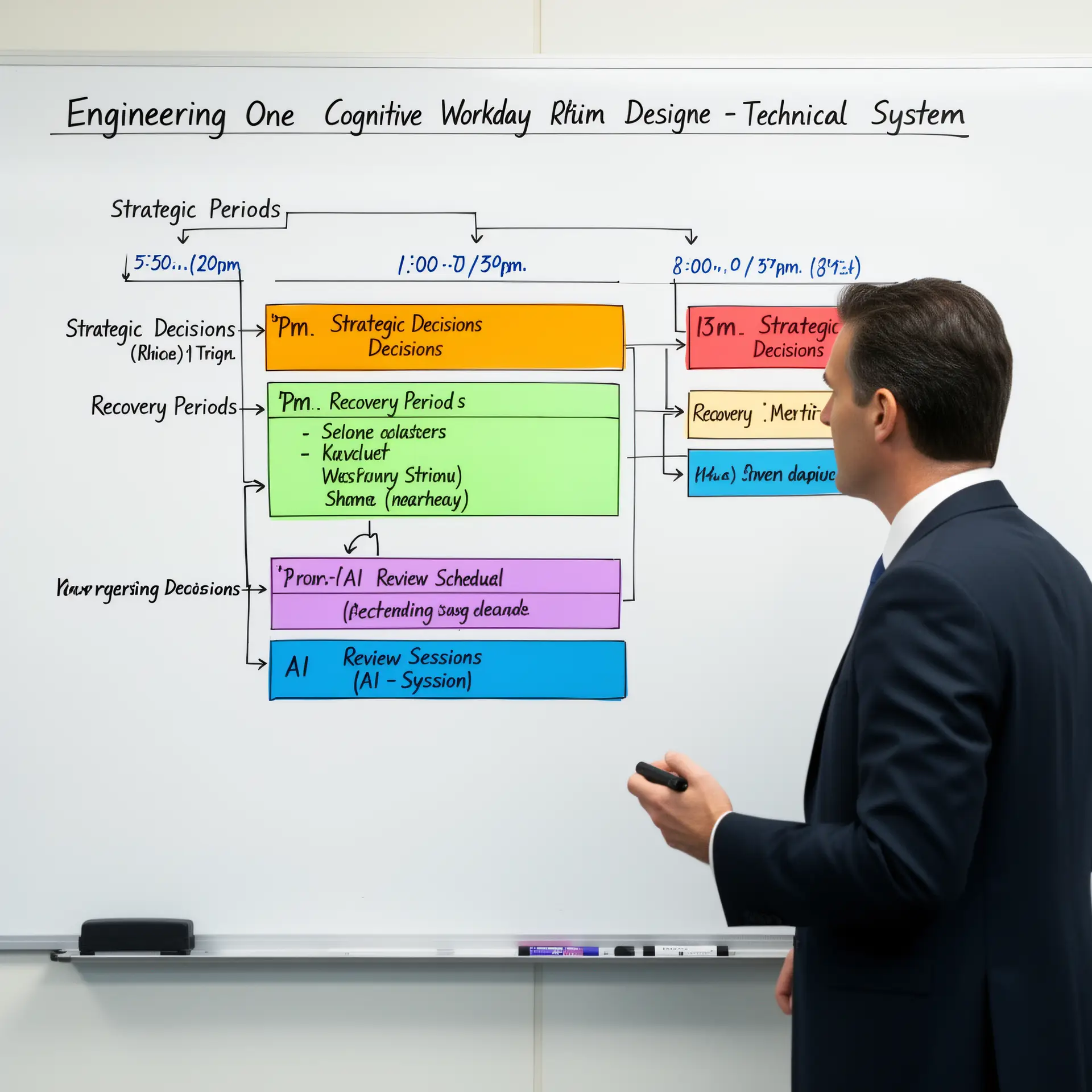
Clear delegation matters more than fast delegation. If your team doesn’t know which decisions they own, they’ll escalate everything, and that flood of small calls lands on an already tired prefrontal cortex. For more on building strong teams, see forging a vision and building a technical identity.
Measuring Cognitive Endurance as a Leadership KPI
If you can’t measure it, you can’t manage it. You won’t get a perfect gauge for cognitive endurance, but proxies work. Here are the ones I track or recommend:
- Decision reversal rate: how often do you walk back calls you made late in the day? A pattern tells you something.
- Calendar density check: map your mistakes and regrets against your calendar. You’ll find clusters.
- Personal metrics: I use HRV and sleep tracking to spot trends before they turn into problems.
- Energy mapping: for one week, note your energy and focus every hour. The pattern will surprise you.
Deloitte’s 2024 Global Human Capital Trends report put human sustainability, including mental well-being, on the leadership agenda. Very few companies actually measure the cognitive load on their own executives. That gap between talking about it and tracking it is where the advantage is.
The Cognitive Endurance Playbook: What I Actually Do
I train in the morning before work. I batch my highest-stakes decisions before noon. I build recovery breaks into the calendar, and even a 15-minute walk between heavy blocks helps. I use AI to pre-process information so I see summaries and options instead of raw noise. And I delegate clearly so my team handles decisions at their level.
I’m not perfect at this. I still take a complex strategic call at 5 PM sometimes and regret it the next morning. But the system works more often than it fails, and that’s the point. You don’t need perfection. You need a system.
In an always-on AI workday, the leader who protects their judgment will outperform the one who just works longer. Build the system. Measure it. Treat your brain like the critical infrastructure it is.