

Leading the Split: How CxOs Build a Bifurcated Market Strategy
Two years ago, picking a network switch was a simple call. You compared specs, checked pricing, and placed the order. Today, that same decision runs through export control screening, supply chain checks, and data residency analysis. Every choice now carries geopolitical weight. A bifurcated market strategy is no longer optional for technology leaders.
This isn’t a think piece about what might happen. It’s happening now. The US CHIPS and Science Act made available $52.7 billion for domestic chip production. The EU Chips Act aims to mobilize more than €43 billion in public and private investment. China keeps pouring resources into homegrown chips. Three major economies are building parallel tech stacks. I’m a CTO serving both federal and commercial customers, and I see it daily. The bifurcated market is the operating reality, not a future risk.
What Bifurcation Means for Technology Leaders
It’s Not Just US vs. China
Most people hear “bifurcation” and think trade war. It’s really a multi-axis fracture. Supply chains are splitting along allied-nation lines. Rules diverge across regions, and data localization requirements keep spreading. Standards for 5G, AI, and quantum have become tools of geopolitical influence. Even your talent pool is shaped by export controls and visa policy.
The split isn’t one clean line. It’s a web of fractures across every part of your business. Each one adds friction, and together they can grind an organization to a halt. That’s why a clear bifurcated market strategy matters right now.
Why This Is Structural, Not a Phase
Some leaders still wait for things to “normalize.” That’s a mistake. When nations pass industrial policy at this scale, they don’t reverse course. The October 2022 US export controls on advanced computing chips, tightened again in October 2023, were a clear break from decades of open chip trade. Most advanced chip production still sits in Taiwan, and every major government sees that as a risk it can’t accept.
Reshoring and “friendshoring” aren’t trends. They’re lasting shifts. CxOs who plan around an eventual reunion will find themselves stuck. The bifurcated market is the new baseline, and your strategy has to reflect that.
The Dual-Stack Framework for Bifurcated Market Strategy
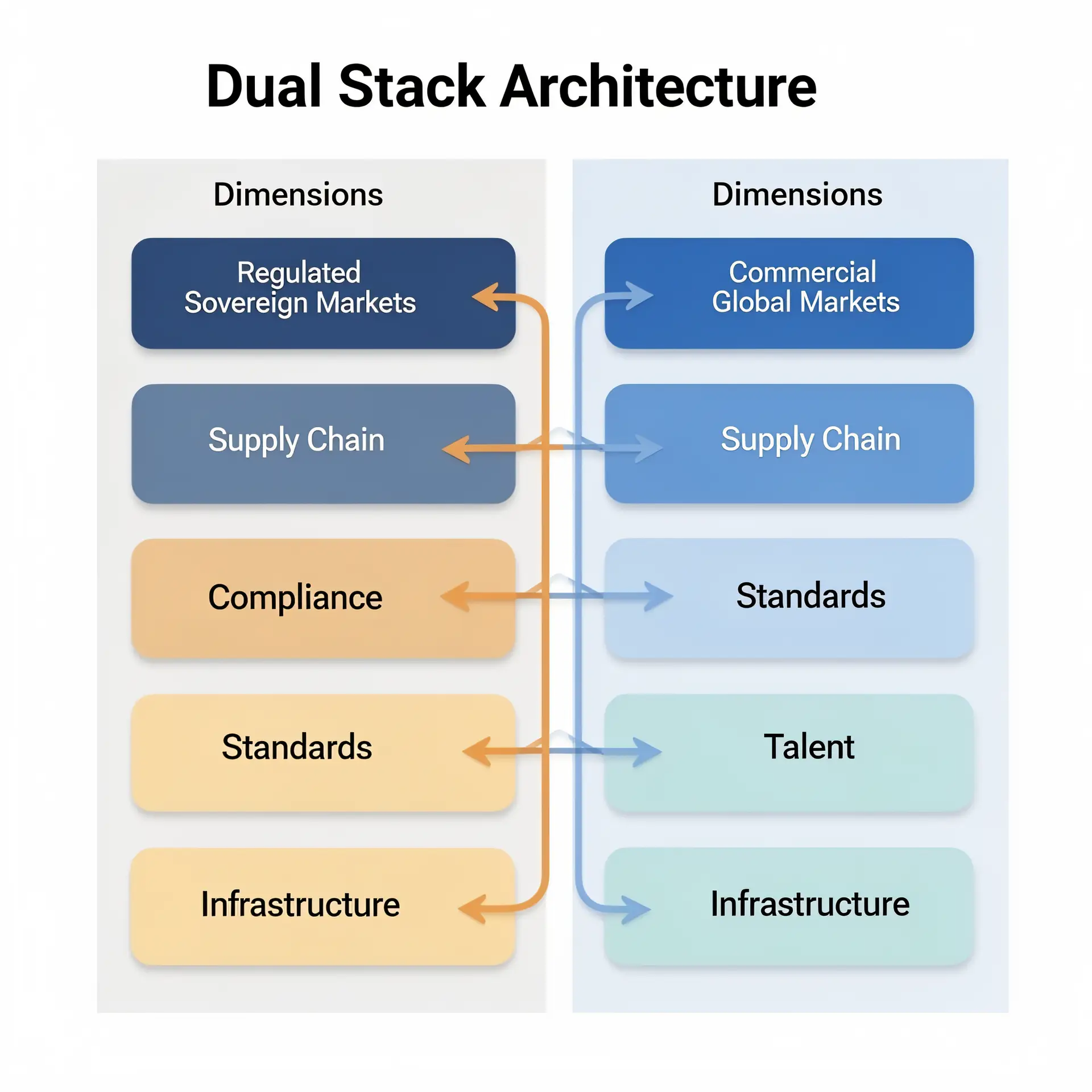
So how do you operate across this without losing speed? I use what I call the Dual-Stack Strategy Model. It covers five areas. Each one forces a clear choice: do we run one approach or two?
Dimension 1: Supply Chain Sovereignty
If you serve US federal customers, you already know Section 889 of the NDAA. It bars government use of gear from Huawei, ZTE, Hikvision, and others. The scope keeps growing, and supply chain risk management rules now demand provenance checks for parts deep in your stack.

The practical step is dual-sourcing with intent. Don’t just find a backup vendor. Build a “clean” supply chain for regulated work, then run a separate commercial pipeline where speed matters more. Yes, this costs more. But Gartner predicted that by 2025, 60% of organizations would use cybersecurity risk as a primary factor in third-party business engagements. Your customers already expect this level of rigor.
For a deeper look at managing complex systems, read our post on application visibility at mission speed.
Dimension 2: Compliance Architecture
GDPR, the EU AI Act, FedRAMP, CMMC 2.0, ITAR, China’s PIPL. You cannot satisfy all of these with a single compliance posture. Build modular governance instead. Create a compliance core that applies everywhere, then layer on region-specific or customer-specific controls.
CMMC shows how fast this moves. For DoD contractors, the DFARS rule took effect on November 10, 2025, and it phases in over three years. Phase 2, which adds third-party certification requirements, began on November 10, 2026. Meanwhile, the EU AI Act sorts AI systems into risk tiers with entirely different rules. If you serve both markets, you need two compliance stacks. Merging them into one creates a slow, bloated monster that satisfies nobody.
A strong bifurcated market strategy treats compliance as a design feature, not a bolt-on. Build the split into your architecture from day one.
Dimension 3: Technology Ecosystem Alignment
The AI hardware decision you make this year could lock you in for a decade. The US ecosystem runs on NVIDIA GPUs, US cloud providers, and Western open-source models. China is building its own parallel world on Huawei Ascend chips and domestic clouds. The EU adds a possible third pole with its strict rules.

Your cloud and AI strategy has to start with a simple question: which ecosystem do your customers live in? For my teams, the answer often means separate builds. Our federal work runs on FedRAMP High and IL4/IL5 environments. Our commercial work uses standard cloud. Different stacks, different vendors, different cost profiles. For more on AI choices at scale, see our guide on AI strategy beyond the hype.
Dimension 4: Workforce Compartmentalization
Bifurcation doesn’t just affect hardware and software. It affects people. ITAR rules limit which team members can touch defense work, and non-US persons face strict access controls on certain projects. That means you need “clean team” structures.
I manage 34 engineers across networking, security, datacenter, and AI. Some work crosses both federal and commercial lines. Some doesn’t. Design your org chart around those realities from the start. Don’t bolt compartments on later. Build them into your team structure, your project flow, and your hiring plan.
Training matters here too. Teams need to understand why the boundaries exist, not just where the lines are. That understanding drives better decisions at every level.
Dimension 5: Decision Velocity
This is the most important piece of any bifurcated market strategy. The biggest risk isn’t making the wrong call. It’s making no call at all. When every purchase could touch export controls, data rules, or supply chain compliance, people freeze. Analysis paralysis becomes the default.

The fix is pre-built decision trees. Define clear criteria in advance. When does a project need the regulated supply chain? When can it use commercial channels? What risk level triggers escalation? I push my teams to document these rules before they face the choice, so when the moment comes they already know the path. For more on this, read our post on executive decision making under pressure.
The Federal Edge: Lessons from the Most Bifurcated Market
Federal and defense work is the canary in the coal mine. We’ve lived with bifurcation for years. ITAR, FedRAMP, Section 889, and now CMMC already mandate a very different tech stack than commercial work. The federal stack and the commercial stack have been splitting for a while. The cost of running both is real, and it keeps growing.
Here’s the upside. Mastering this split becomes a competitive moat. The barrier to entry in federal IT keeps rising, and firms that can operate on both sides of the divide become hard to replace. I’ve seen rivals exit the federal space entirely because they couldn’t justify the dual-stack cost. That creates room for those who can.
The lessons from federal work are spreading. Commercial firms now face similar pressures around data residency, AI governance, and supply chain openness. What felt like a government-only headache two years ago now shows up in commercial RFPs. A bifurcated market strategy built on federal lessons gives you a head start in commercial markets too.
Where AI Makes This Harder, and Where It Helps
AI ecosystem bifurcation is the sharpest edge of this trend. Export controls on advanced AI chips forced a clean split between US and Chinese AI paths. If you build AI solutions, you need to know which side of that line your customers sit on. For context on the hardware debate, see our breakdown of GPUs vs. purpose-built ASICs for AI.
AI also helps manage bifurcation. Compliance tools can scan rule changes across regions in near real time. AI-powered supply chain platforms improve tracking and risk scoring. Language models can watch sanctions lists and export control updates faster than any human team.
The irony is real. The technology causing the fastest bifurcation also offers the best tools to manage it. Leaders who use AI to run their bifurcated market strategy will outpace those who don’t.
Keeping Speed in a Fractured World
Speed is the real casualty of market bifurcation. A purchase decision that used to take a week can now take a quarter. That’s deadly for firms that compete on agility.
The answer isn’t to skip the checks. It’s to make them routine. First, build your decision frameworks before you need them. Second, invest in compliance tooling that removes manual steps. Third, delegate authority clearly. Not every bifurcation decision needs to reach the CTO’s desk.
Keep a bias toward action. Perfect data doesn’t exist in a splitting world. Make the best call you can with what you know, document the logic, and adjust as things change. The CxOs who thrive aren’t the ones who wait for clarity. They’re the ones who build systems to move fast despite the fog.
You Don’t Get to Opt Out
The bifurcated market is here. It’s structural, and it’s picking up speed. You can build for it or get managed by it.
The CxOs who treat bifurcation as a strategic skill, not just a compliance burden, will turn it into advantage. They’ll win customers who need a partner that can work across the split. They’ll move faster because their decision frameworks are already in place. And they’ll build teams that understand why the rules exist, not just what the rules say.
Start with the five dimensions. Map where your firm sits on each one. Find the gaps. Then build your bifurcated market strategy before the next fracture forces your hand. In a bifurcated market, the worst strategy is pretending you don’t need one.