
“`html
AI for Business Leaders: The Gold Rush Where Most Companies Come Home Empty-Handed
Let me be blunt. Everyone is talking about AI right now. In fact, vendors pitch it like magic and company boards demand it like oxygen. As a result, most companies are spending real money with very little to show for it.
I say this as a CTO who has pulled cable and supported Fortune 50 networks. I also helped grow a defense contractor from 12 people to over 100 employees and over $500M in revenue. I’ve seen every tech hype cycle since the early 2000s. AI is different, and it’s certainly real. However, the gap between the pitch and the payoff is enormous.
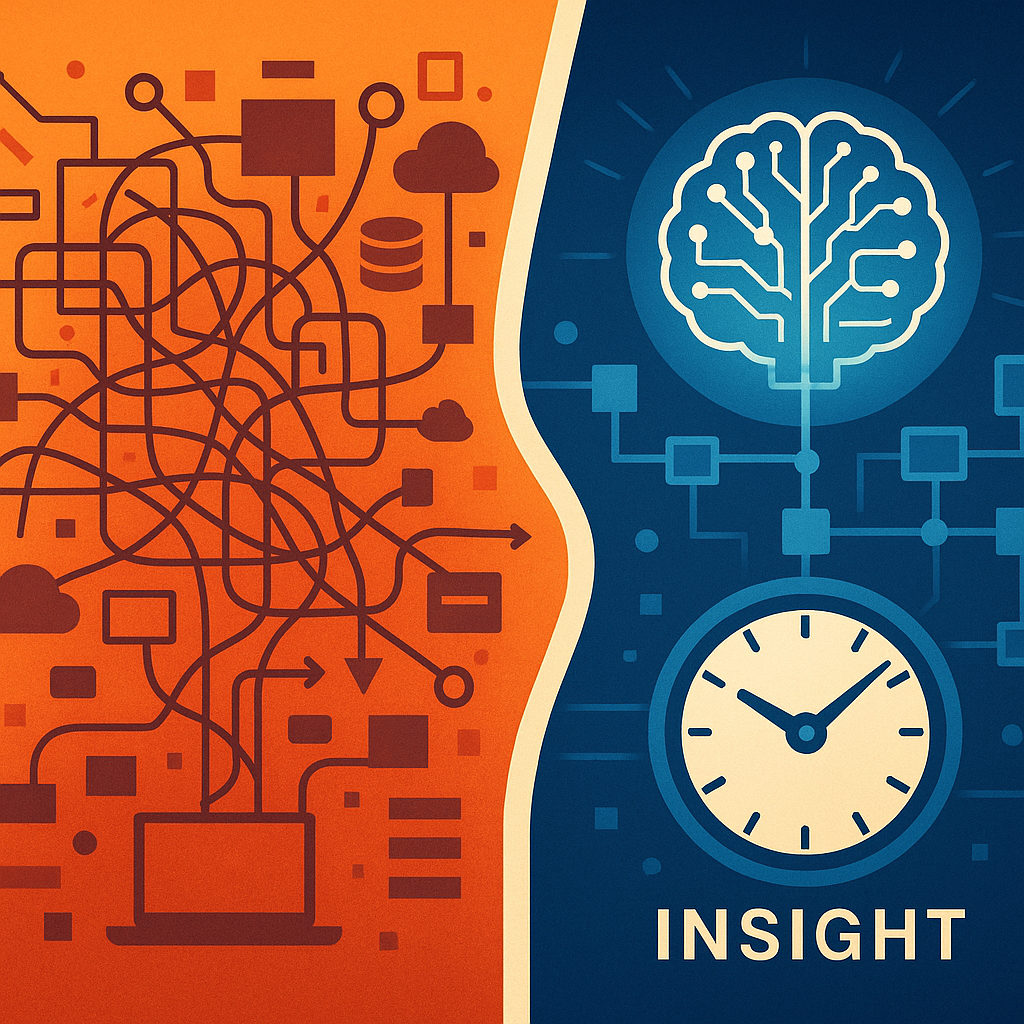
According to McKinsey’s 2024 State of AI report, 72% of companies have adopted AI in at least one function. Yet, only about 15% have scaled it with real ROI. This means most leaders are stuck in what I call pilot purgatory. They have a cool demo, but they don’t have a business result. So let’s cut through the noise. Here’s what a real strategy for AI for business leaders looks like when it meets reality.
AI Strategy Is Business Strategy—Start With the Problem
The Business-Backed Approach to AI
The biggest mistake I see is leaders treating AI as a tech project. For instance, they hand it to IT and say, “Go do AI things.” Unfortunately, that’s a recipe for a wasted budget.

In fact, the best AI plans start with a clear business problem. For example, you might say, “Our proposal response time is too slow.” Or perhaps, “Our security team can’t triage alerts fast enough.” You must start with the pain. Then you can work backward to the right tool.
AI without a business case is just expensive hardware. I have watched companies buy GPU clusters before they even knew what question they wanted to answer. That’s like buying a squat rack before you know how to stand up straight. Ultimately, you’re going to hurt yourself.
What Scaling From 12 to 100+ Taught Me
When I joined Colossal in 2018, we had only 12 people. Consequently, every process was manual. Proposals took forever (or at least required a lot of late nights and a ton of copy and past content), and knowledge lived only in people’s heads. We grew fast, but that growth exposed every single crack in our foundation.
Looking back, AI could have helped us earlier. Specifically, it could have sped up proposal drafts. It also could have automated network design templates and flagged project risks sooner. Today, we are using AI tools for exactly these things. The lesson here is simple. AI’s real value for services companies is operational leverage. It’s not about building a new product. It’s about doing more with the team you already have.
Before You Buy the AI, Fix Your Data
The Unsexy Truth About Data Readiness
Here’s what nobody puts on the conference slide. Your data is a mess. Ours was too (and in some pockets, still is). Most companies have data that is siloed, dirty, and ungoverned. Of course, AI models are only as good as the data they eat.

Gartner estimates that 80% of AI projects will fail to deliver value through 2025. Moreover, 60% of those failures trace back to data quality, not bad models. In other words, the algorithm isn’t the problem. The data is. This is why wrangling enterprise data is the first real step.
Before you spend a dollar on AI tooling, ask yourself three questions. First, where does our data live? Second, is it clean and consistent? Third, who governs it? If you can’t answer those clearly, you must start there.
Data Governance as a Competitive Advantage
I know data governance sounds boring. It is boring. But it’s also the foundation that separates companies who scale AI from those who stay stuck in pilot mode.
Think of it like this. When I decided at 39 to get in the best shape of my life, the sexy part was hitting a new deadlift PR. The unsexy part was fixing my diet and tracking my sleep. I had to show up consistently for two years. As a result, I lost 75 pounds and broke every high school lifting PR I had. The transformation didn’t come from a fancy supplement. Instead, it came from disciplined fundamentals. Data governance is the diet and sleep of your AI strategy. It’s not glamorous. However, it is what makes everything else possible.
Build, Buy, or Partner: A Decision Framework for AI for Business Leaders
When Off-the-Shelf Works
The market is flooded with SaaS AI tools. You have Copilot, Gemini, Claude, and dozens of platforms for specific fields. For many use cases, buying is the right call. For example, if you need AI-assisted writing, code generation, or meeting summaries, don’t build custom models. Just buy the tool and train your team.

Additionally, off-the-shelf tools are faster to set up. They also require less in-house talent. And they keep getting better through vendor updates. For straightforward tasks, this is certainly the smart move. For Colossal, we chose Ask Sage, since it was a shim between all the models. It allowed us to meet strict Federal security requirements around handeling Controlled Unclassified Information (CUI), while also giving us the flexibility to use any model, both public (i.e. Gemini, ChatGPT, Claude, etc.) and even models we built or trained ourselves.
When Custom Models Are Worth It
On the other hand, custom models make sense when your data is unique. They also work when your workflow is specific. For instance, if you have special network design patterns from years of federal work, a custom model trained on that data could give you a real edge. The key question is this: does this AI need to know things only we know? If the answer is yes, then building or fine-tuning makes sense. If not, don’t reinvent the wheel.
The Federal and Defense Nuance
This is where my world gets complicated. In defense contracting, you can’t just spin up a cloud AI service and call it done. FedRAMP, CMMC, ITAR, and classification rules create a different playing field entirely. This is a core challenge for AI for business leaders in my space.
Models cannot train on data that crosses security boundaries. Consequently, many federal AI projects require on-prem or air-gapped environments. Partnering with experts can help with empowering federal agencies with AI. The average time to get an Authority to Operate (ATO) for AI systems runs 12 to 18 months. That’s a real cost that commercial leaders don’t face. Nevertheless, the Department of Defense/War is moving fast. The Chief Digital and AI Office (CDAO) oversees more than 800 AI initiatives. The DOD’s AI budget even topped $1.8 billion in FY2024. The opportunity is massive, but only for leaders who understand the compliance landscape.
You Don’t Need a Data Science Army—You Need AI-Literate Engineers
Upskilling Your Existing Team
Here’s great news for CxOs watching their budgets. You probably don’t need to hire a dozen data scientists. The tools have gotten that easy to use.

In fact, low-code platforms and pre-trained models mean your current engineers can do more than you think. What you actually need is AI literacy across the organization. Specifically, your people need to know what AI can and can’t do. They need to spot good use cases. Furthermore, they need to work alongside AI tools daily. That is why upskilling for tomorrow is so critical.
I manage over 30 engineers at Colossal. They range from cable technicians to CCIEs working on collaboration, security, and more. Most of them don’t need to build neural networks. But they all need to use AI-assisted tools effectively.
From CCIEs to AI-Augmented Engineers
Consider this evolution. A CCIE who spent years mastering network design can now use AI-driven analytics. They can spot issues in minutes that used to take hours. Similarly, security analysts using AI-powered SIEM tools can triage threats faster. They can do this with fewer false positives.
This isn’t about replacing experts. It’s about amplifying them. As a result, a 100-person company can punch well above its weight. It can compete against firms with thousands of employees. That’s the real promise of AI for services firms.
Furthermore, my own career proves that curiosity beats credentials. I dropped out of college to chase a music career. I came back and earned my CCIE through hard study. Eventually, I became a CTO. AI will reward the same trait. The people who win won’t have the fanciest degrees. Instead, they will be the ones who learn fast and apply new tools to real problems.
The Infrastructure Nobody Wants to Talk About
GPUs, Network Fabrics, and Power Realities
Most AI strategy articles skip this part, but I won’t. AI workloads need specific compute, storage, and networking. We’re talking GPUs, high-speed storage, and special network fabrics. They also need serious power and cooling. You need to weigh the pros and cons of GPUs vs. purpose-built ASICs for your specific needs.

If you’re making AI strategy decisions without understanding these limits, you’ll blow your budget. For example, a single rack of GPU servers can draw 40 to 100 kW of power. Your existing data center may not support that. Above all, you need to plan your infrastructure before you plan your models.
Why CTO Technical Depth Is a Strategic Asset
This is where I push back on the idea that CTOs should be pure strategists. In the AI era, a CTO must understand the details. A leader who knows HPC architecture, data center power, and network design brings a huge advantage. This is especially true in conversations about AI for business leaders.
When I sit in a meeting about AI investment, I can tell you if our systems can support the workload. I can also estimate the real cost. This includes not just the software license, but the compute, network upgrades, and cooling. That technical depth saves us from expensive mistakes. As Harvard Business Review has noted, AI projects fail when leaders lack the technical understanding to ask the right questions.
Governance, Risk, and Responsible AI—Not Optional Anymore
The Regulatory Landscape Is Real
Bias. Hallucination. Explainability. Accountability. These aren’t theoretical concerns anymore. In fact, they are operational risks with real consequences.
The NIST AI Risk Management Framework and Executive Order 14110 on Safe, Secure, and Trustworthy AI are creating real compliance rules. Yet only 22% of companies have built AI governance frameworks, according to Stanford’s HAI AI Index.
If you wait to build governance until regulators force your hand, you’ll pay a huge cost. Therefore, you should start now. Even a simple framework covering data use, model testing, and bias checks is better than nothing.
The Special Burden in Defense
In federal and defense work, AI governance isn’t just smart—it’s a mission requirement. Decisions informed by AI can have life-or-death results. Consequently, responsible AI frameworks must be baked in from day one, not bolted on later.
The military’s approach offers lessons for every business leader. First, have mission clarity before technology selection. Second, assess risk in every decision. Finally, have clear objectives with team autonomy. These principles work whether you’re deploying AI in a classified network or a commercial one.
Measuring What Matters: AI ROI in Business Terms
Beyond Model Metrics to Business Impact
Your data science team cares about model accuracy. Your board does not. Most importantly, you need to define AI success in terms the business understands. This is the only way for AI for business leaders to get continued funding.
That means you must track revenue impact and cost reduction. You also need to measure time saved and employee productivity. Specifically, set baseline metrics before you deploy AI. Then, you can measure the lift afterward. Without this discipline, you can’t build the case for more investment.
For instance, if AI cuts your proposal response time from two weeks to three days, your board gets that number. If it reduces false positive security alerts by 40%, your security team can do higher-value work. Companies that scale AI see 3 to 5 times higher ROI than those in pilots. The difference is they measure business outcomes, not just technical metrics.
The Bottom Line: A CTO’s Honest Take on AI for Business Leaders
What I’m Actually Doing With AI
At Colossal, we are not chasing AGI. Instead, we are using AI to work smarter. We are testing AI-assisted proposal drafting. We’re exploring AI-driven network diagnostics for our engineering teams. Additionally, we’re looking at automation for security monitoring and project forecasting.
None of this is flashy. All of it is practical. And that’s the point. AI’s biggest near-term value for a services company like ours is force multiplication. It helps our 100-person team compete against firms ten times our size.
My Advice to Fellow CxOs Cutting Through the Noise
After more than 20 years in this industry, here is my honest take on AI for business leaders. AI is real and it matters. But strategy beats hype every single time. So, don’t chase the shiny thing. Chase the business result.
Here’s your Monday morning checklist:
- Pick one business problem. Not three. One. The one that costs you the most time or money right now.
- Audit your data. Can you actually feed an AI model with clean, governed data for that problem? If not, you must fix the data first.
- Start with buy, not build. Test an off-the-shelf tool for 90 days. Then, measure the result in business terms.
- Upskill your team. Get your engineers using AI tools daily. Your goal should be literacy, not a separate AI department.
- Build governance now. Even a basic framework for data use and bias checks will save you pain later.
AI won’t transform your business overnight. Similarly to my fitness journey, the results come from disciplined fundamentals applied over time. There is no shortcut. However, if you do the work, the payoff is very real. Stop chasing the gold rush and start building a strategy.
That’s how you win.
Ready to modernize your infrastructure without the usual migration headaches? Whether you’re looking to scale your AI capabilities or shore up your cybersecurity posture, you don’t have to navigate the complexity alone.
Reach out to Colossal if you want some help—we’ll help you turn that technical roadmap into reality.











Leave a Comment