
Everyone has AI now. Your competitor has it. Your intern has it. A startup built a product on ChatGPT last weekend. So here is the hard truth: having an AI idea is no longer a strategy. The real AI factory premium goes to those who build the operating system behind the intelligence, not just the intelligence itself.
I see this play out every week. Companies come to us with “AI projects.” They want a chatbot, a classifier, a smart dashboard. Almost every time, I ask the same question: “Great. Now what happens after the demo?” Most of the time, silence. That silence is the gap between an idea and a factory. And it is where all the money lives.
The Idea Trap: Why Having AI Is Not a Strategy
Foundation Models Are Now Utilities
GPT-4, Claude, Llama, Gemini. Pick one. They are all good. They are all easy to reach. In other words, the model layer has become a commodity. You can spin up a proof of concept in an afternoon.

Getting that concept into production is a different problem. Keeping it there and making it better over time? Even harder. That gap is where the AI factory premium starts to matter.
Here is the data that should worry you. Gartner found in 2024 that only 10 to 15 percent of enterprise AI projects make it to production. McKinsey’s State of AI report showed that 72 percent of groups struggle to scale AI beyond pilot projects.
Most companies are stuck in the demo loop. They prove the idea works. Then they fail to build the system that makes it last. If you have dealt with enterprise data sprawl, you know this challenge well.
The Commodity Tax Is Real
If your AI product is a wrapper around someone else’s model, you face margin squeeze. It is only a matter of time. As foundation models get cheaper and better, the value of your “clever prompt” drops to zero.
Companies like Jasper and others have already felt this pressure. The market does not pay a premium for ideas. It pays an AI factory premium for systems that scale and repeat.
What Is an AI Factory Premium Worth?
Jensen Huang’s Industrial Metaphor
At GTC 2024, Nvidia CEO Jensen Huang defined the AI factory concept. It is simple: a facility that takes in raw data and produces intelligence. Just like a factory takes in raw materials and produces goods.
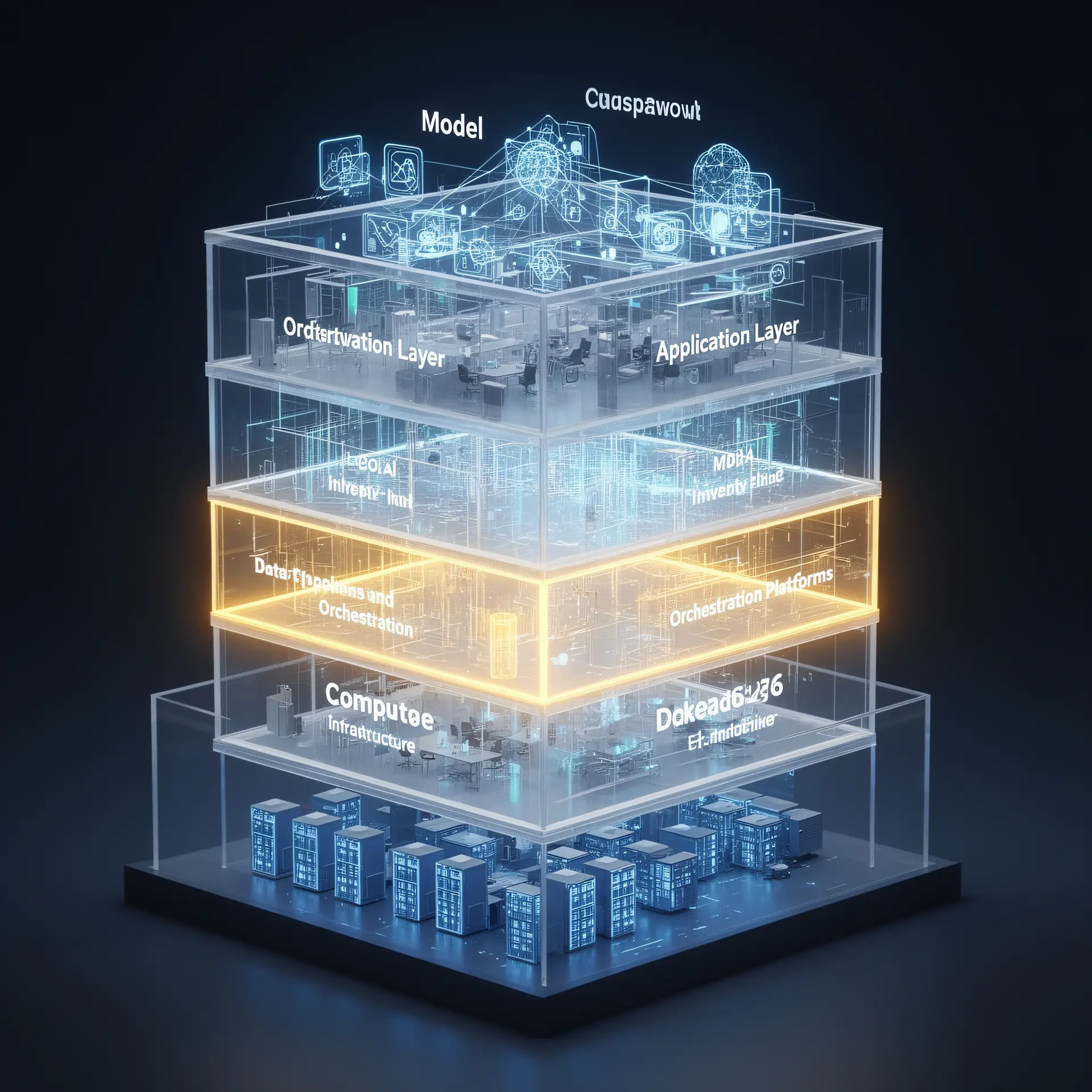
The AI factory includes data intake, model training, fine-tuning, testing, deployment, and retraining. All as a repeatable, industrial process. This is more than marketing. Nvidia shifted its own business model to match.
NVAIE (Nvidia AI Enterprise) is a recurring subscription platform. It is not a one-time hardware sale. When the world’s largest GPU company pivots from selling chips to selling an operating system, pay attention.
The Stack You Need to Understand
The AI factory stack has five layers. First, compute from Nvidia and cloud providers. Second, data from Databricks and Snowflake. Third, orchestration from LangChain, LlamaIndex, or custom tools. Fourth, models from OpenAI, Anthropic, or open source. Fifth, your custom apps.
Most companies focus on the top and bottom. They pick a model. They build an app. The real AI factory premium lives in the middle: the data and orchestration layers.
That is where your proprietary knowledge sits. That is where lock-in happens. That is what the market rewards.
The Pattern CxOs Should Recognize
Platform Companies Always Win the Long Game
We have seen this movie before. AWS did not win by hosting websites. It won by becoming the operating system for cloud-native companies. Salesforce did not win by being a better contact list. It won by becoming the operating system for revenue operations.

In each case, the durable winner built the platform, not the product. The AI wave follows the same playbook. Palantir trades at roughly 25 times revenue. Databricks hit a $43 billion private valuation, per TechCrunch.
Compare that to typical enterprise SaaS companies at 5 to 8 times revenue. The market clearly prices in an AI factory premium for companies that operate as AI operating systems. Feature providers get left behind.
Where the AI Factory Premium Shows Up in Practice
Data Gravity Creates the Real Moat
Once your data flows through a specific AI operating system, switching costs become huge. Fine-tuning pipelines, vector databases, RAG setups, feedback loops. All of it compounds over time.
This is the same dynamic that made Oracle and SAP nearly impossible to rip out of enterprises for decades. Groups that build AI factories around their own data create moats that pure-play AI app companies simply cannot copy.
This is especially true in regulated sectors like defense, healthcare, and financial services. The harder the environment, the bigger the premium.
Recurring Revenue Beats Project Revenue
The AI factory model changes how you make money. Instead of selling AI projects at fixed prices, winners sell ongoing access to AI systems. Think usage pricing, platform licenses, and managed services.
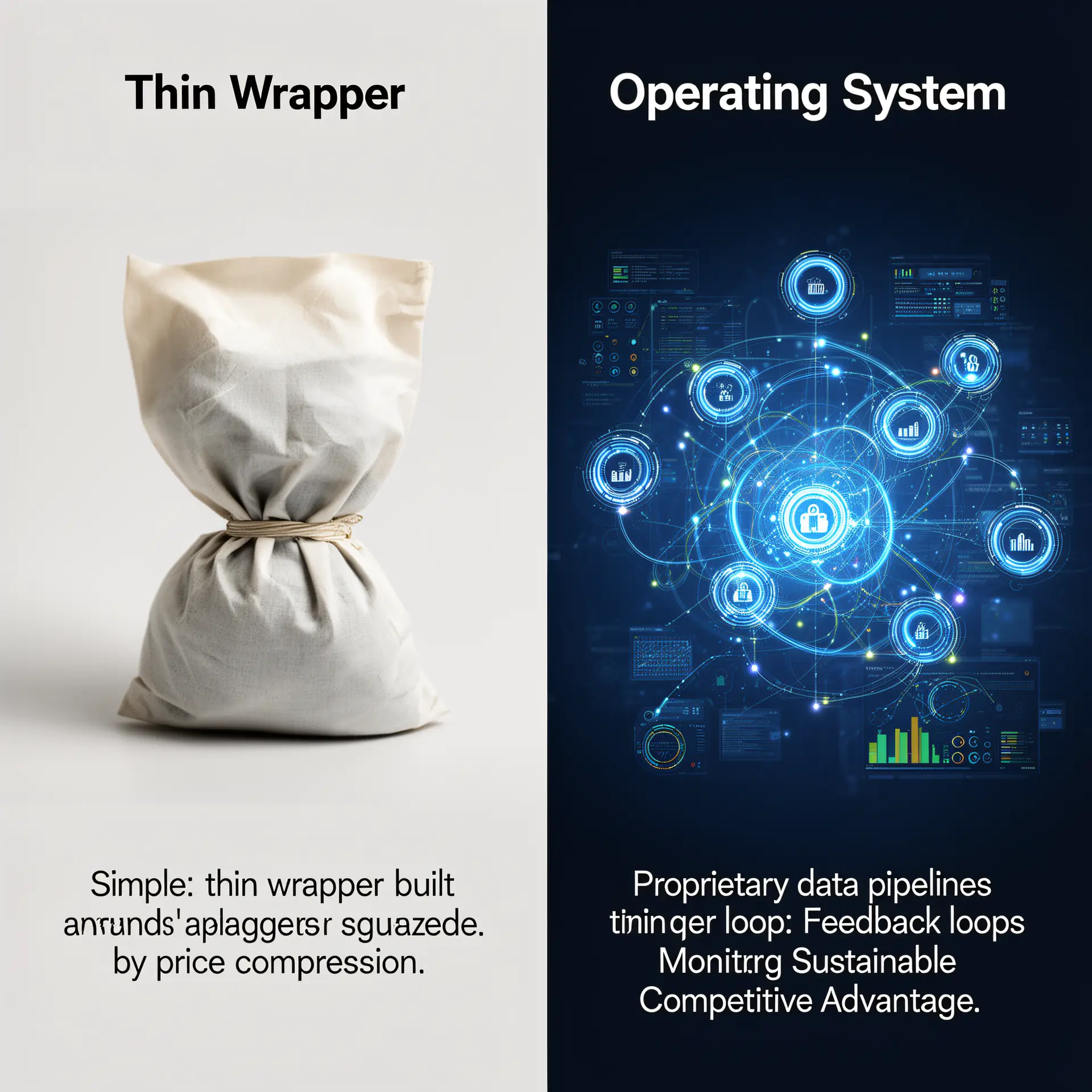
This shifts revenue from lumpy project income to steady recurring revenue. The market rewards that shift with higher multiples, every time.
For fellow CxOs at IT solutions companies: if you are still selling AI as one-off services, you are leaving the premium on the table. Stop selling projects. Start selling systems. For a deeper look at AI strategy beyond the hype, I covered the broader landscape in a prior post.
The CxO Decision: Build, Assemble, or Get Left Behind
Own the Middle, Rent the Edges
Most enterprises will not build their AI factory from scratch. That is fine. The real strategic call is which parts to own and which to rent. My advice: rent compute and models. Own orchestration and data.
That is where your company knowledge lives. That is your edge. CxOs who outsource the entire stack become tenants. Those who own the operating layer become landlords. The gap in long-term value is massive. Making this call well requires strong decision-making under pressure.
Your Talent Bottleneck Is Not What You Think
I lead 34 engineers across enterprise networking, security, datacenter, and AI. I can tell you firsthand: the bottleneck is not “we need more data scientists.” The bottleneck is the absence of a production-grade AI operating system.

The best data scientist in the world is useless without a pipeline to deploy, monitor, and retrain models. The talent model flips in the AI factory premium era. You need MLOps engineers, data pipeline architects, and platform engineers. Not just researchers with Jupyter notebooks.
The 10x engineer today is the one who can ship and iterate. Companies with strong AI practices are 3.5 times more likely to report revenue impact. That stat alone should change your hiring plan.
The Federal and Defense Premium Is the Biggest of All
In the federal market, the AI factory premium is even more clear. The DoD’s Chief Digital and AI Office is building AI systems as a shared service. They are not funding one-off science projects. Programs like CJADC2 demand auditable, ATO-compliant AI pipelines.
The global push toward sovereign AI makes this bigger. The EU AI Act, FedRAMP rules, ITAR controls, and HIPAA all mean the same thing: AI factories built for hard settings command outsized premiums.
An AI factory inside a classified boundary is worth far more than one in a public cloud sandbox. DoD AI and data budget requests topped $3 billion for FY2025. That is real money flowing to factory-model companies. Federal teams also need upskilling in AI and automation to make these systems work.
What This Means for Your Group Right Now
Three Questions Every CxO Should Ask Today
First, do we own our data and orchestration layers, or are we renting our entire AI stack from someone else? Second, can we deploy, monitor, and retrain a model in production today, or are we still stuck in the demo loop? Third, is our AI revenue tied to one-time projects, or recurring platform access?
If you answered “renting,” “stuck,” and “projects,” you have work to do. You have about 18 months of work to do, in fact.
The 18-Month Window for the AI Factory Premium
The AI factory market is locking in fast. The global AI systems market could top $200 billion by 2028. The MLOps tooling market alone could grow from $2 billion to over $12 billion in that same period.
The companies that lock in their spots as AI operating system providers in the next 18 months will be very hard to displace. Waiting is the most costly option. Not because the tech will pass you by. But because your rivals will build data gravity and lock in customers.
They will set up the recurring revenue base that funds their next moves. You will still be pitching demos. Build the factory. Own the operating system. Let everyone else fight over the ideas. That is where the AI factory premium lives, and it is real.